GE has built home appliances in Louisville, Kentucky since long before the Haier era, and that manufacturing depth deserves a technician who understands it. In Indiana we are the recognized name for ge repair Indiana, reaching the capital at Indianapolis and the cities of Indianapolis, Fort Wayne, Evansville, South Bend, Carmel across a population of about 6.9 million, and we cover every GE line: refrigeration, cooking, dishwashing, laundry and ice.
Why the Indiana climate shapes GE repair Indiana
Indiana’s continental climate — muggy summers, freezing winters — is demanding on a GE suite. Humidity drives moisture into gas igniter ports, surfacing continuous clicking, while the deep winter freeze contracts refrigerator and oven door gaskets so they no longer seal cleanly. Hard water across much of the state scales a GE dishwasher and the refrigerator water line, so igniter service, gasket work and descaling lead our Hoosier State calls.
GE appliances we service in Indiana
From GE Profile French-door refrigerators to GDT-series dishwashers and GTW-series washers, we cover the entire GE range:
- Washers — GTW-series GE top-load washers — electronic-control models read GE’s own E-codes (E22 fill timeout, E23 drain timeout, E42 motor/inverter overload, E45 door-lock overload), while older mechanical-dial machines are symptom-led
- Dryers — GE electric and gas dryers — read from GE’s documented E1/E2/E3 code set on electronic-control models, with restricted airflow diagnosed as an E3 vent-blockage symptom on any platform
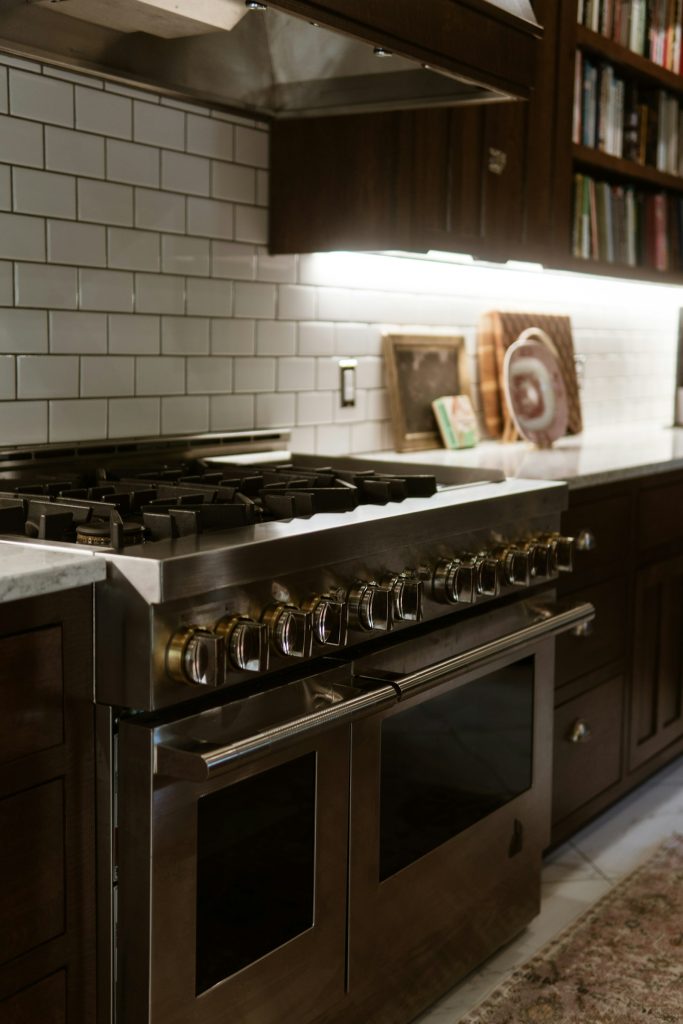
- Ranges — freestanding GE ranges built around GE’s own electronic oven control — serviced from the documented F-code set on the electric side, and from ignition symptoms on the sealed gas burners, which display no code
- Wall Ovens — single and double GE and Café electric wall ovens — read from GE’s own published F-code scheme (F0/F1/F6/F7 touchpad, F3/F4 sensor, F9/FC door lock, F350 cooling-fan circuit), with a sensor or door-lock failure the most common calls
- Dishwashers — GDT-series GE dishwashers — GE publishes a genuine, detailed code set (C1-C3 drain restriction, C4 float/refill, C6/C7 water-temperature sensor, Leak Detected) that we read directly rather than guessing at a fill or drain symptom
- Freezers — GE upright and chest freezers — some electronic models show trade-documented alerts (E7 button stuck, E8/E9 thermistor failures, HI/HRS high-temperature alert), while dial-control chest and manual-defrost uprights carry no display and are diagnosed by symptom
- Refrigerators — GE, GE Profile and Café refrigerators — French-door, top-freezer and side-by-side models read behavior-based alerts (FF/CC temperature warnings, dE for a defrost cycle that has not run, PF after a power failure) on many models, so we diagnose cooling, ice and water issues by symptom alongside any code shown
- Ice Makers — built-in and GE Profile Opal nugget ice makers — a built-in fridge icemaker signals trouble through the refrigerator’s own CI alert, while the countertop Opal shows model-specific E1/E2/E3/T3 codes we verify against the manual before quoting a fix
- Wine Coolers — GE and Café wine and beverage coolers — GE has published no standard numeric code list for these units, so every not-cooling, temperature-drift, dual-zone imbalance or noisy-compressor issue is diagnosed by symptom, honestly, with no invented codes
- Range Hoods — GE and Café range hoods — GE has no standard error-code system for hoods, so we diagnose by symptom: a fan or light that has gone dead, one speed missing, unusual noise, or weak suction traced to the switch, blower motor or capacitor
- Microwaves — JVM-series GE over-the-range microwaves — GE documents a real sensor and touchpad code set (F1/F2 thermal sensor, F4/F5 humidity sensor, F3/F10 touchpad or touchscreen), which we read directly rather than guessing
The problems we resolve most in Indiana
Certain GE problems appear in Indiana more than elsewhere, and most trace back to humid ignition and cold-cracked gaskets. On the cooking side, expect continuous clicking from a wet GE gas burner port, a no-light from a clogged port or weak igniter, and F-codes (F3/F4 sensor, F9/FC door lock, F2/F20 over-temp) on the electric oven. On the cleaning side, a GE dishwasher reads C1-C3 for a drain restriction, and a washer reads E22 or E42. A refrigerator signals trouble by behavior on most basic models — not cooling, an evaporator-fan symptom, a temperature alert — and a dryer that won’t heat usually has a failed heating element (flagged by E1/E2) or a clogged vent (E3); wine coolers, range hoods and freezers are read by symptom. We resolve those at the same visit, parts in hand.
Statewide coverage across Indiana
We dispatch experienced technicians to metro areas including Indianapolis. Beyond the major metros, smaller Indiana communities are reached on a planned rotation so wait times stay short and most jobs wrap up in a single trip. Our coverage spans all 50 states plus DC, the booking desk runs day and night, and our standard response is 24 to 48 hours, with same-day visits where availability allows.
Reading genuine GE error codes
Honesty matters here: a GE appliance displays real, manufacturer-defined codes where the electronics support one, and where they do not we never invent one. GE ranges and ovens use F3/F4, F9/FC and F2/F20; GE washers use E22, E23, E42 and E45; GE dryers use E1, E2 and E3. The refrigerator signals trouble mostly by behavior on basic models and by FF/CC/dE/PF alerts on smarter ones, and gas burners, wine coolers and range hoods are symptom-led. Both the codes and their fixes live in our error-code library.
Keeping your GE appliances healthy in Indiana
Given Indiana’s conditions, seasonal care protects your appliances. Keep the sealed gas burners’ ports and igniters clean and dry so they never click endlessly, clean the dishwasher filter and the dryer vent regularly, and wipe refrigerator and oven door gaskets. Treat a persistent F9/FC door-lock failure, a recurring C1-C3 drain code, or a dryer E3 vent-blockage problem as urgent and book a technician rather than risking a bigger failure. Small, early fixes always cost less than the control board or pump a neglected appliance eventually needs.
Pricing and scheduling in Indiana
Costs are clear from the start. A diagnostic visit runs from $89, and the total price — driven by the model, parts and configuration — is agreed in writing before any repair; we never quote a fixed price sight unseen. We fit only genuine GE OEM or high-quality replacement parts, and our labor carries a 30-day labor warranty. Book via our online scheduling form, or browse the full repair services; the manufacturer’s own specs are at the manufacturer’s site at geappliances.com.