A ge washer wont spin diagnostic flow is most effective when it follows a specific order, since spin failure can stem from several unrelated systems and checking them in the wrong sequence wastes time. Whether your GE washer is a top-load or front-load model, the same general logic applies: confirm the machine is allowed to spin, confirm it actually drained, then check the mechanical drive path.
Step 1 – Confirm the lid or door is satisfying the safety switch
No washer will spin if its control system does not detect the lid or door as fully closed and locked. On top-load models, gently press the lid switch while a spin cycle is attempted; a switch that does not click firmly may need replacement. On front-load models, listen for the door lock engaging (often an audible click a few seconds into the cycle) – a door that engages the mechanical latch but fails the electrical lock confirmation will block spin.
Step 2 – Confirm the tub actually drained
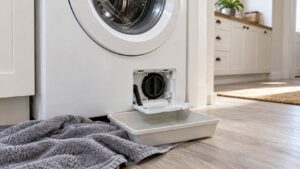
Most washers, GE included, will not begin a spin cycle until the tub has fully drained, since spinning a tub full of water risks damage and poor results. If the washer is failing to drain – see our related guide on GE washer not draining – a spin failure may actually be a drain failure in disguise. Check for a kinked drain hose, a clogged pump filter, or an active E23 drain-timeout code before assuming the spin mechanism itself is responsible.
Step 3 – Check for an unbalanced load
An unbalanced load, particularly a single bulky item like one towel or a comforter, can trigger a protective pause that prevents spin from starting or completing. Redistribute the load evenly and confirm the washer is level using a bubble level before moving further down the diagnostic path.
Step 4 – Check the drive system
If the lid/door switch tests fine, the tub has drained, and the load is balanced but the washer still will not spin, the issue has likely moved into the mechanical drive path – a worn drive belt (on belt-drive models), a failing motor coupling, or on direct-drive models, the motor itself or its control circuitry.
Step 5 – Check for an active error code
Electronic-control GE washers may display a code like E42 (motor/inverter overload) or E45 (door thinks locked) pointing directly at the failed stage – always check the display before assuming which step in this flow applies.
When to call a technician
Once the safety switch, drain, and load balance have been ruled out, our washer repair technicians can test the drive belt, motor coupling, and motor control circuitry directly to confirm the mechanical cause.
Belt-drive vs. direct-drive: why the ge washer wont spin diagnostic differs by design
Older GE top-load washers typically use a belt connecting the motor to the transmission and basket, while most current GE top-load and all front-load models use a direct-drive motor coupled straight to the tub or drum without a belt. On a belt-drive machine, a burnt-rubber smell or a visible belt lying loose in the cabinet base is an immediate giveaway – a worn or snapped belt lets the motor run (you may hear it) while the basket stays completely still. On a direct-drive washer, the equivalent failure is a worn motor coupling, a small plastic or rubber part designed to shear intentionally under an extreme overload to protect the transmission from damage; that same self-sacrificing design means a stripped coupling is actually a normal, expected failure after enough overloaded cycles rather than a sign something else is wrong. Knowing which drive type your model uses before opening the cabinet saves real diagnostic time, since a belt inspection is irrelevant on a direct-drive machine and vice versa – confirming your model’s drive type is one of the first things to establish at the very start of any ge washer wont spin diagnostic visit.
Quick summary
A ge washer wont spin diagnostic that checks lid/door switch, drain completion, and load balance before the drive system saves time and avoids replacing a belt or motor when the cause was simpler.
Our experienced, independent technicians – not affiliated with GE Appliances, a Haier company, or General Electric Company – follow this exact diagnostic sequence on every spin-failure call. Schedule service at /schedule/. General GE product information is at geappliances.com.