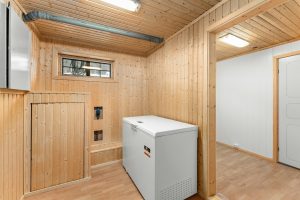
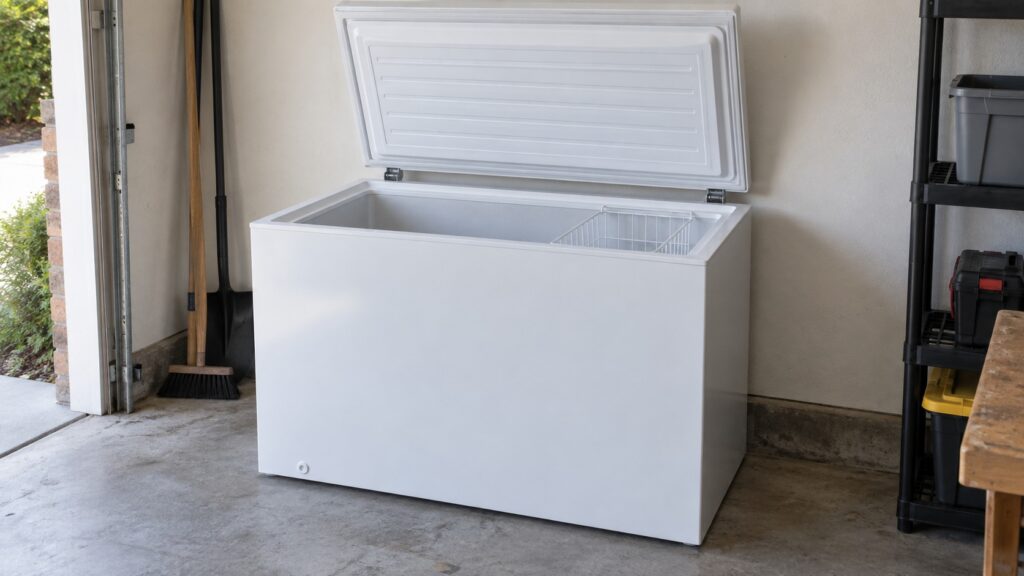
The GE FCM7SKWW is a 7.0 cu. ft. manual-defrost chest freezer, and it is the middle rung of a four-model line that runs from 5.0 to 15.7 cu. ft. on one platform. If you are comparing it against the numbers either side of it, the honest answer is that the mechanism is the same in all four: a hinged lid, a mechanical thermostat, a drain plug and no defrost cycle. What changes with the number is how much you can freeze and how much floor the box takes.
What exactly is the GE FCM7SKWW?
A white top-opening chest freezer, finished inside as a single molded liner, with a hinged lid and a counterbalanced hinge that holds it open while you dig. The feature list on the GE FCM7SKWW is short and deliberate: manual defrost, an adjustable thermostat, an interior light, a defrost drain and one sliding storage basket.
That short list is the point of the format. There is no fan, no defrost heater, no defrost timer and no control board — the four parts that account for most of the service calls on a modern freezer simply are not there. A chest freezer is a compressor, a thermostat, a length of tubing bonded to the liner and a lid gasket. Fewer parts is why these boxes routinely outlive the kitchens they were bought for.
The trade you make is the one you feel every week: no automatic defrost, and everything stacked vertically in a box you have to lean into. Our comparison of the chest and upright formats works through that choice in general terms. This page stays with the numbers on the badge.
How much actually fits in 7.0 cu. ft.?
The rule of thumb used by every appliance salesperson is about 35 pounds of packed food per cubic foot, which puts the FCM7SKWW at roughly 245 pounds — a quarter of a beef, or a summer’s worth of a productive garden, or the chest part of a two-freezer household. The FCM5SUWW takes about 175 pounds; the FCM11PHWW about 370; the FCM16DLWW about 550.
Two corrections to that arithmetic are worth making before you choose. First, a chest freezer is only as efficient as it is full, and a half-empty box cycles more and frosts faster. Buying one size up “for later” costs you in running expense every month until later arrives. Second, the number that fills faster than you expect is the basket, not the box: one basket comes with the FCM7SKWW, and everything under it is a stack you will have to lift to reach.
Measure the doorway before the alcove. A 15.7 cu. ft. chest is wider than many basement stairs and interior doors will take, and the return trip is the expensive part of that discovery.
What does manual defrost really ask of you?
Every model in the FCM line is manual defrost, and that is not a gap in the specification — it is the reason the box is cheap to run and simple to repair. There is no heater on a timer melting the frost away every few hours, so the frost accumulates, and once or twice a year you deal with it.
- Frost grows from air, not from food. It comes in every time the lid is up, and it comes in continuously through a gasket that has hardened or a lid that is not sitting square.
- A quarter-inch of frost is the trigger. Past that, the liner cannot move heat into the tubing, and the compressor runs longer for a warmer box.
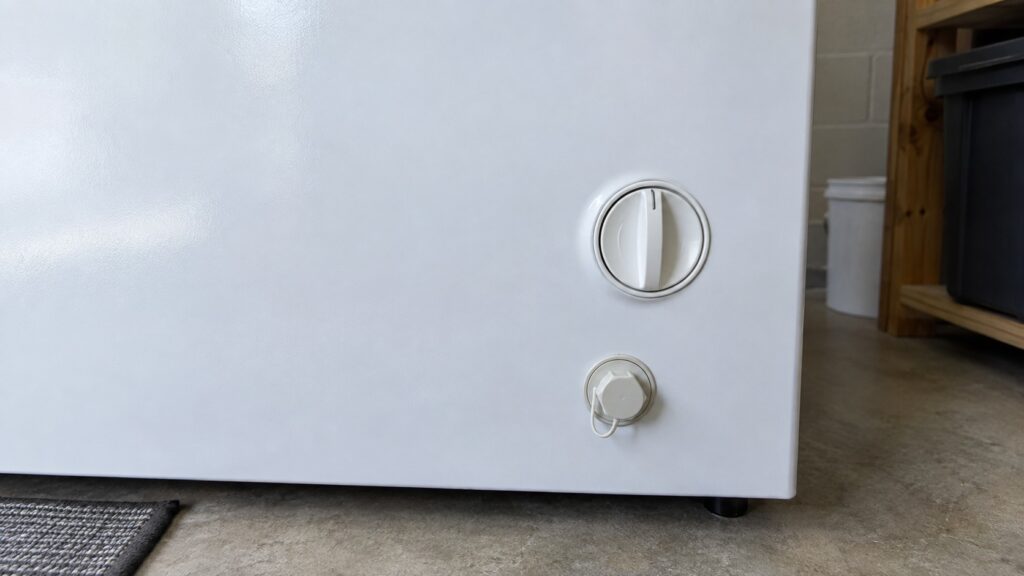
- The drain plug is the whole tool kit. Unplug the freezer, open the lid, pull the plug at the front and let the water run into a shallow pan. Never chip frost with a knife or a screwdriver: the refrigerant tubing is bonded directly behind the liner, and a puncture ends the freezer that afternoon.
The step-by-step version, including what to do with the food while you wait, is in our guide to defrosting a GE freezer. If frost is coming back within weeks rather than months, the gasket or the lid seal is the thing to look at, and our page on frost and ice buildup covers the checks.
FCM chest or FUF upright — which belongs in a garage?
This is where the two halves of the GE freezer line genuinely differ, and where people searching a bare model number most often end up in the wrong aisle.
The FUF14DLRWW is a 14.1 cu. ft. frost-free upright that is rated for garage use. Frost-free means a heater and a fan clear the coil on a schedule, so you never defrost it by hand; garage-rated means the control is designed to keep working when the surrounding air is cold enough that an ordinary freezer would let its compressor rest and the contents thaw.
An FCM chest has no such rating on its badge, but it has a different advantage in the same room: with no fan and no automatic defrost, there is much less to be confused by cold ambient air, and the mass of frozen food in a deep box rides out a power cut far longer than an upright with shelves and a door. If the freezer lives somewhere unheated and you want to forget it exists, the FUF is the easier appliance. If you want the lowest running expense and the fewest parts, the FCM line is still the better box. Whichever one you choose, the placement rules in our GE freezer installation guide apply: clearance behind, a level floor and its own outlet.
Why does a chest freezer never show an error code?
Owners who come to the FCM line from a modern refrigerator sometimes look for a display and worry that they are missing a warning. They are not. GE chest and manual-defrost units carry no codes at all — they are diagnosed by symptom. The electronic uprights are the ones that talk: E7 for a button held more than thirty seconds, E8 for a shorted thermistor, E9 for an open one.
On an FCM, the symptom is the diagnosis. A box that runs constantly but stays warm points at the thermostat, the start relay or the compressor. A box that is silent points at power, the thermostat or the relay. A box that freezes hard and frosts fast points at the gasket and the lid. Three symptoms, a short list of parts behind each — which is why these freezers are usually worth repairing well past the age at which a frost-free unit is not.
What should you check before you call anyone?
Before assuming the worst on any FCM, confirm the outlet with something else, confirm the thermostat has not been knocked to its lowest setting during a clean-out, and confirm there is not an inch of frost doing the insulating. Those three account for a large share of the calls we take on this line.
If the box is still warm after that, the parts involved are few enough to price honestly. A visit starts from a standard diagnostic call and the estimate is confirmed before any work begins. We are an independent repair company, not a factory service arm, and on a chest freezer we will tell you plainly when a start relay is worth fitting and when a compressor is not. The full specification page for this model is at our GE FCM7SKWW entry; for anything that needs hands, see GE freezer repair, schedule a visit or call (844) 524-4561.