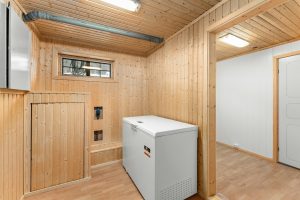
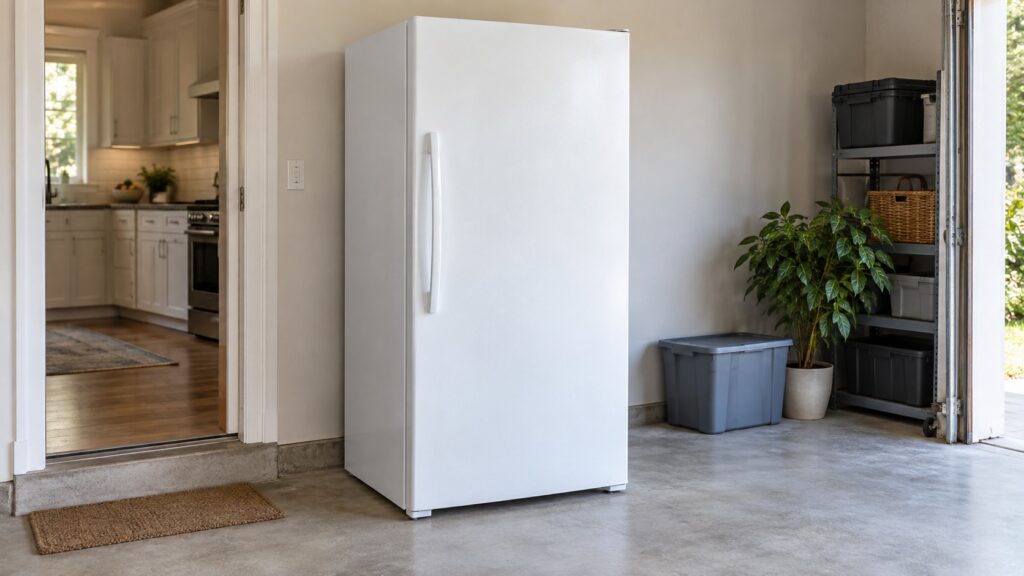
A standalone freezer is the easiest major appliance to install badly, because it usually goes somewhere nobody thinks of as a room — a garage, a basement, a utility corner. GE freezer installation has only four requirements, and three of them are about where it stands rather than how it is connected.
The garage problem, which almost nobody is warned about
A freezer’s thermostat measures the cabinet, but the control assumes it is sitting in a heated room. In a garage that drops below the model’s rated minimum, the control concludes nothing needs doing — and the compressor stops running while the contents slowly warm toward the room temperature. In a cold snap the food stays frozen because the room is cold; in a mild spell it thaws.
The symptom is food that has softened in January on a freezer that appears to be working. Models sold as garage-ready handle this with a heater or different control logic; an ordinary freezer does not. If the space drops below the rated minimum, the answer is either heating that space or a different appliance — not a colder setting.
Heat has to go somewhere
A freezer removes heat from inside and releases it into the room through a condenser at the back or underneath. Pushed tight against a wall, wedged between a wall and a shelf unit, or with boxes stacked on top, it cannot. The compressor then runs longer for the same result, the appliance is louder, and its life shortens quietly.
Leave the gap the manual specifies at the back and sides, and keep the top clear. In a basement or garage, also plan for the dust: a condenser in an unconditioned space loads far faster than one in a kitchen, and vacuuming it twice a year is the largest free saving available — see our freezer maintenance guide.
Power, and the extension cord question
- A grounded outlet, ideally on a circuit not shared with power tools or a sump pump.
- 🔴 No extension cord. A compressor starting draws hard, and a thin cord drops voltage at exactly the wrong moment. This is the most common installation shortcut and the most damaging one.
- Nothing that switches off. A freezer on a circuit with a switch someone can flip, or on a GFCI that nuisance-trips in a damp garage, is a freezer that will fail silently.
- Consider an alarm. A cheap temperature alarm in an unattended space is worth more than any feature on the appliance.
Level, and the door that should close itself
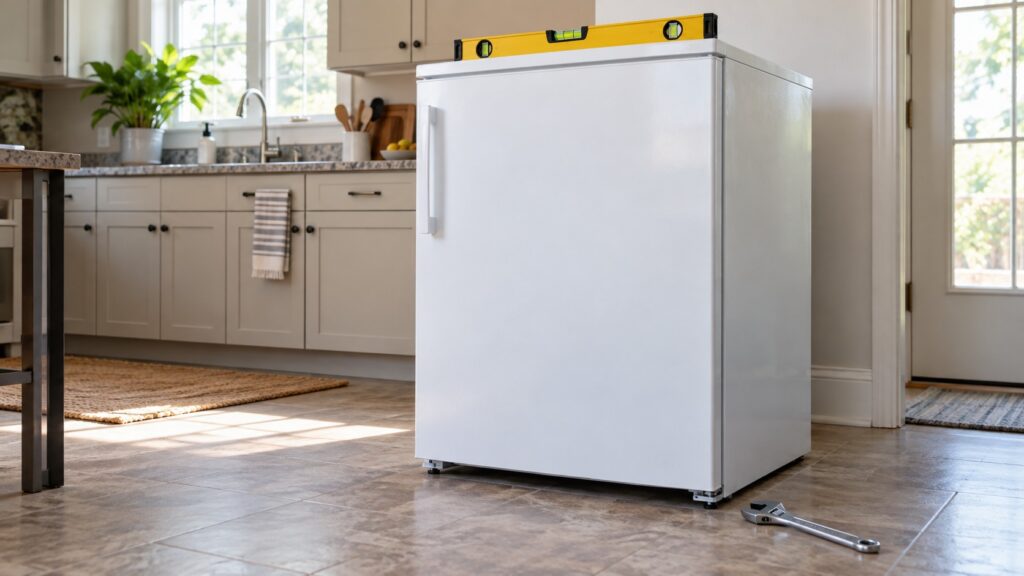
An upright freezer’s door should swing shut under its own weight from a small opening. That is achieved with a very slight backward tilt — front feet a fraction higher than the rear. A cabinet level or tipped forward gives a door that stands open, and a freezer door left ajar overnight is how a full load is lost.
Check it after loading, not before. A loaded freezer settles, and a floor in a garage is rarely as flat as it looks. A chest freezer is less fussy about tilt but still wants to be level so the lid seals along its whole length.
Chest or upright changes the siting
A chest freezer holds cold better when opened, because cold air is heavier than warm and stays in the box. It also needs floor space and a clear arc above for the lid. An upright is easier to organize and loses more cold per opening, but it takes a footprint you can walk past.
Both matter for where they go. A chest in a tight garage bay with a car parked close cannot be opened; an upright against a wall that the door swings into is equally awkward. Our chest against upright guide covers the trade in detail.
Getting it there, and the doorway nobody measured
A chest freezer is wide and a full-size upright is tall, and both are heavier than they look. Measure the route rather than the appliance: the narrowest doorway, the turn at the bottom of a basement stair, and the headroom where the unit has to be tipped upright at the end. A chest freezer that fits the space perfectly and not the stairwell is a delivery that goes back.
Keep it upright on the way if you possibly can. Transporting a refrigeration appliance on its side moves compressor oil into places it should not be, and the remedy is the standing time described below — which people skip when a delivery arrives late in the day.
The first day
If the freezer traveled on its side, stand it upright for several hours before switching on, so oil that has moved in the compressor drains back. Then let it run empty for several hours before loading it — a freezer filled with room-temperature groceries on hour one has to pull all of that down at once and will read warm for a while through no fault of its own.
Load it gradually if you can, and fill any empty space with containers of water. Thermal mass is what carries a freezer through a door opening and through a power outage, and it costs nothing.
Commissioning, and when to call
Put a thermometer inside and check it after a full day — that reading is your baseline for every future question about this appliance. Confirm the door seals with a strip of paper at several points. Listen: a steady hum is normal, a rattle usually means something is touching the cabinet.
We are an independent repair company, not an installer, so we have nothing to sell you on this job. What we see afterward is the pattern: extension cords, boxed-in cabinets and ordinary freezers in unheated garages. If yours is in and something is not right, GE freezer repair starts with a diagnostic visit, we confirm the estimate before any work begins, and you can schedule a visit online.