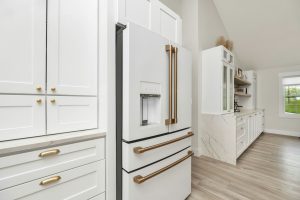

A ge ice maker buying guide decision typically comes down to whether you already have (or are buying) a refrigerator with a built-in icemaker, or whether you want a dedicated standalone unit for a specific ice style or a location away from the refrigerator entirely.
Built-in refrigerator icemakers
Most GE refrigerators, particularly French-door and side-by-side models, include or support an add-on built-in icemaker that produces standard cubed ice directly into an in-door or in-freezer bin, connected to your home’s water supply. This is the most seamless option since it requires no separate countertop space or reservoir filling, but it produces one general ice style and its output rate is limited compared to a dedicated ice-production appliance.
The GE Profile Opal nugget icemaker
The Opal is a standalone countertop unit specifically designed to produce nugget-style ice – the soft, chewable ice popularized by restaurant soda fountains – using its own internal water reservoir rather than a plumbed connection. This makes it easy to place anywhere near an outlet, including outside the kitchen entirely, but it needs its reservoir refilled manually and produces a specific ice style rather than standard cubes.
Comparing ice output and speed
Built-in refrigerator icemakers typically produce ice at a steady but modest pace suited to everyday household use, while a dedicated unit like the Opal is designed to produce a larger batch of its specialty ice type relatively quickly, which matters more for entertaining or households that go through ice heavily.
Water quality considerations
A built-in icemaker relies on your home’s water supply and benefits from a properly maintained water filter – see our related guide on GE ice maker producing small or hollow cubes, since filter condition directly affects cube quality. A reservoir-fed unit like the Opal depends on whatever water quality you fill it with, so using filtered water can reduce mineral buildup and extend maintenance intervals.
Installation complexity
See our related guide on GE ice maker installation for the fuller comparison, but in short: built-in kits involve a water line connection and wiring, while standalone units like the Opal need only an outlet and manual reservoir filling.
Which option fits your needs
- Choose a built-in refrigerator icemaker for everyday, hands-off standard ice production integrated into your existing refrigerator
- Choose a standalone unit like the Opal if you specifically want nugget-style ice, need placement flexibility away from the refrigerator, or want a higher-output secondary ice source
How a ge ice maker buying guide approaches diagnosing problems later
Neither a built-in refrigerator icemaker nor a standalone unit like the Opal uses a published numeric error-code list the way a GE dishwasher or oven does – a refrigerator’s display may show a general CI alert tied to the icemaker circuit, but beyond that both types are diagnosed by symptom: no ice production, small or hollow cubes, a batch that never fully forms, unusual grinding noise, or a unit that runs but the bin never fills. Troubleshooting either type later relies on describing symptoms accurately, not reading a code off a screen.
Noise and placement considerations in a ge ice maker buying guide comparison
A built-in refrigerator icemaker cycles quietly in the background since it is integrated into a unit already running continuously, while a standalone unit like the Opal has its own compressor and harvest cycle that produces an audible crunching sound each batch – worth considering before placing it somewhere noise-sensitive, like a home office or bedroom wet bar.
Lifespan and long-term maintenance
A built-in refrigerator icemaker generally lasts as long as the refrigerator itself, since it shares the same water supply and electrical system, while a standalone unit like the Opal is a separate appliance with its own wear parts and its own service life, meaning it can be replaced or serviced independently without affecting refrigerator operation at all – a genuine advantage for households that use one heavily.
Quick summary
The right choice in a ge ice maker buying guide depends more on the ice style and placement flexibility you want than on any single feature – many households end up with both a built-in icemaker and a standalone specialty unit for different purposes.
Whichever type you choose, our experienced, independent technicians – not affiliated with GE Appliances, a Haier company, or General Electric Company – service both. Schedule service at /schedule/. General GE product information is at geappliances.com.