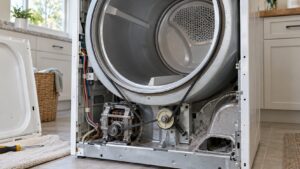

The ge oem aftermarket parts decision comes up on nearly every repair once a technician identifies the failed component. OEM stands for original equipment manufacturer – a part built to the exact specification the appliance was originally designed around, whether sourced directly through GE’s parts channels or from the same manufacturer that supplied the original component. Aftermarket parts are made by third-party manufacturers to fit the same application, with quality that varies considerably from one supplier to another.
What OEM parts offer
- Exact fit and dimensional match to the original component, reducing installation issues
- Consistent material and tolerance quality, since the part is built to the same specification as what came with the appliance
- Predictable long-term behavior, since the part was engineered specifically for that model platform
What aftermarket parts offer
- Often a lower upfront cost than an equivalent OEM part
- Wide availability, sometimes faster to source for older or discontinued models
- Highly variable quality – some aftermarket manufacturers produce parts that perform nearly identically to OEM, while others use lower-grade materials that fail sooner
Where the choice matters most
For parts under continuous mechanical or electrical stress – a compressor, a control board, a motor, or a door lock assembly – the quality gap between OEM and a poor aftermarket substitute tends to show up fastest, sometimes causing a repeat failure within months. For simpler, lower-stress parts like a door gasket, water filter housing, or basic hardware, a well-reviewed aftermarket option can perform reasonably close to OEM at a lower cost. Our own refrigerator repair, dishwasher repair, and other service pages reflect where we typically prioritize OEM sourcing based on the component involved.
Sourcing the right part either way
Whichever route you choose, the part number has to match your specific model exactly – GE has produced many model variations over the years, and a part that fits one GNE-prefix French-door refrigerator will not necessarily fit another. Confirming your exact model and serial number before ordering any part, OEM or aftermarket, is the single best way to avoid an expensive mismatched order.
What a technician typically recommends
A technician performing a repair will usually recommend the option that balances reliability against cost for your specific situation – OEM for a critical, high-stress component on a unit you plan to keep for years, and a reputable aftermarket option where the savings are meaningful and the part’s duty cycle is lower. Being upfront about this tradeoff, rather than defaulting to whichever option is more profitable to sell, is part of an honest repair estimate.
A note on independence
Because this is an independent repair service, we are not required to source parts exclusively through any single supplier, and we can discuss both OEM and aftermarket options honestly based on what actually makes sense for your appliance and budget.
Warning signs of a poor-quality aftermarket part
Not every ge oem aftermarket parts decision is obvious from a listing alone. Watch for a part number that only “cross-references” to your model rather than being listed as a direct fit, no manufacturer name attached at all, or a price dramatically below every other option – signs of a generic part not engineered to GE’s tolerances. Reviews mentioning early failure or a part that “almost” fit are worth taking seriously, since forcing a part into place stresses surrounding components during installation – this is exactly the kind of ge oem aftermarket parts tradeoff worth a few extra minutes of research before ordering.
Warranty considerations
Using a low-quality aftermarket part on a component still under manufacturer warranty can complicate a future claim, so check coverage status before making the ge oem aftermarket parts call on a system still under its original protection window.
Quick summary
OEM parts generally offer the most reliable long-term fit and performance, especially for critical components, while aftermarket parts can be a reasonable choice for lower-stress parts when sourced from a reputable manufacturer – the right answer depends on the specific part and how long you plan to keep the appliance.
Our experienced, independent technicians – not affiliated with GE Appliances, a Haier company, or General Electric Company – can walk you through the OEM-versus-aftermarket tradeoff for your specific repair. Schedule a diagnostic visit at /schedule/. General GE product information is at geappliances.com.