
GE washer repair cost varies mainly with which part actually failed, and the common failure points on a GE washer map fairly cleanly to the error codes covered elsewhere in our guides, which makes the cost conversation a lot more concrete than a vague estimate.
The failed part itself
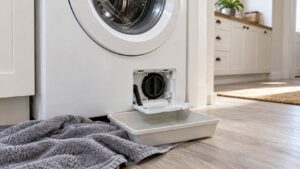
- Drain pump, tied to E23 or E30-type drain problems – generally a moderate-cost repair, more involved if the pump sits deep in the cabinet
- Water inlet valve, tied to the E22 fill-timeout code – usually a lower-cost, quicker repair
- Door lock assembly, tied to the E45 code – typically moderate, since it involves the door frame area
- Motor, inverter module, or transmission – typically the higher end of the range, since these parts cost more and involve more labor time
- Control board, tied to a persistent E58-type problem – generally on the higher end as well
Accessibility and labor time
Front-load washers often require more disassembly to reach internal components like the drain pump or motor than top-load models do, which adds labor time regardless of the part’s own cost. A part reachable through a simple front panel is inherently quicker to service than one requiring the drum or suspension to be partially disassembled.
Diagnostic time
A washer displaying a clear error code narrows the diagnosis considerably compared with a symptom-only complaint, like the causes covered in our GE washer not spinning guide, where several unrelated components can produce the same symptom. More diagnostic time generally translates into more labor time on the final invoice.
Single-visit versus return-visit repairs
- Common parts like inlet valves, door locks, and pump filters are frequently carried on the service vehicle and completed in one visit
- Less common parts, such as a specific control board or motor assembly, may need to be ordered, requiring a return visit
- A return visit typically adds only the part cost and a shorter follow-up labor charge, not a second full diagnostic fee
Repair versus replacement
If a diagnostic shows the needed repair – a full motor and control board replacement on an aging unit, for instance – would approach the cost of a new washer, replacement may be the more sensible choice. A technician worth trusting will say so plainly rather than pushing an expensive repair on a machine near the end of its useful life.
Why the part matters more than the brand tier
Whether your washer is a base GE model or a GE Profile unit with additional features, the core drain, fill, lock, and drive components are broadly similar in complexity, so ge washer repair cost tends to track the specific failed part more than which tier of the lineup you own.
Getting the most accurate estimate
Noting the exact error code shown on the display, if any, and describing whether the symptom happens every cycle or only sometimes helps a technician narrow down likely causes before even arriving. That short bit of preparation is one of the few things a homeowner can do to keep ge washer repair cost as predictable as possible, since it reduces the odds of a diagnostic turning into a longer, more exploratory visit.
Weighing age against repair scope
An older washer with a straightforward, lower-cost repair ahead of it is almost always worth fixing, while the same washer facing two or three simultaneous failures starts to tip the math toward replacement. A technician who lays out the full scope of what is wrong, rather than quoting one part at a time, gives you the clearest picture of where your specific machine sits on that spectrum.
Quick summary
GE washer repair cost comes down to the specific part, how accessible it is, and how much diagnostic time is needed, rather than a flat number, and an honest, itemized diagnosis upfront is the best way to know whether repair or replacement makes more sense.
For an accurate, honest estimate, our experienced, independent technicians diagnose the actual failed part before quoting anything. Schedule a diagnostic visit at /schedule/. General product information is available at geappliances.com.