GE washers: series and lineup
GE washers span mechanical dial-controlled top-loaders and electronic front-load and Direct-Drive top-load models, with the model prefix and control type determining whether a problem surfaces as a code or purely as a symptom. Electronic top-load models such as the GTW720BSNWS carry GE’s GTW prefix and run a full electronic control board, while older mechanical-dial top-loaders and some legacy GLC/Hydrowave models rely on a timer dial and, on some units, a diagnostic flash pattern rather than a text code. Reading the full model and serial tag before diagnosing a ge washers call still matters, since GE’s serial format (first letter month, second letter year) confirms the unit’s real age independent of the model number. You can browse the units we service in our model directory.
Technologies and features
GE’s electronic washer lineup includes front-load and top-load formats with sensor-based fill and drain monitoring, and the control board actively watches for fill timeouts, drain-pump signal loss, and motor overload conditions rather than running on a fixed mechanical timer. Mechanical-dial GE washers keep the older, simpler approach — a timer advances the cycle regardless of sensor feedback, which is more serviceable in some ways but leaves fewer diagnostic clues when something goes wrong. Across both platforms, the parts that wear are the water inlet valve, the drain pump, the door or lid lock assembly, the drive motor or inverter, and the main control board — the same components, whether or not the unit displays a code for the failure.
Common issues and maintenance
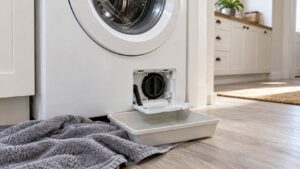
On electronic GE washers, the confirmed error codes are E22 (the tub did not fill within the expected time), E23 (the tub did not drain within the expected time, which can trigger flood-protect mode), E30 (no signal is being received from the drain pump), E42 (a motor or inverter failure, often from an overloaded load), E45 (the door thinks it is still locked, again often overload-related), and E58 (a main control failure). Mechanical-dial GE top-loaders show no such display, so those units are diagnosed by symptom: a washer that won’t drain usually means a clogged pump or kinked hose; excessive vibration during spin often points to unlevel feet or a worn suspension component; and a washer that won’t fill traces back to the same inlet-valve or water-pressure causes regardless of control type. Loading the drum evenly, not overloading past the rated capacity, and leaving the lid or door slightly open between cycles to prevent gasket mildew prevent most of these calls. An E42 or E45 code, in particular, is worth checking against the load itself first — redistributing an unbalanced load and restarting the cycle resolves a real share of these problems without any part ever needing to be replaced, and it is always worth trying before assuming the drive motor or door lock has actually failed. For code meanings, see our GE washer error codes, and browse repair guides for symptom-based troubleshooting on mechanical ge washers models.
When to call for repair
A failed inlet valve, drain pump, door or lid lock, drive motor or inverter, or main control board are best handled by experienced technicians who read the code (or symptom, on mechanical units) before ordering a part. As an independent, third-party repair service, we are not affiliated with, authorized by, or endorsed by GE Appliances (a Haier company) or General Electric Company, and our technicians back every visit with a 30-day labor warranty on the workmanship. Note the exact code or symptom and your full model and serial number when you book. Schedule GE washer repair or book an appointment online, and you can review current GE listings at geappliances.com.