A microwave that hums but will not turn the plate is one of the most common service calls we get, and the good news is that the ge microwave turntable parts involved are simple, inexpensive, and mechanical rather than electronic. There is no error code for a stuck turntable on any GE microwave — this is a mechanical wear issue, not a control-board or sensor problem, which is exactly why it is worth understanding before you assume the worst.
How the Turntable System Works
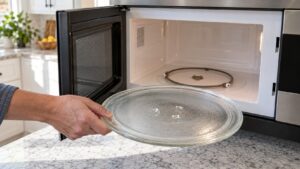
Underneath the glass tray sits a roller guide (a ring with small wheels or rollers), and beneath that a plastic drive coupler that connects to a small turntable motor mounted in the cavity floor or under the unit. The motor turns the coupler, the coupler engages the roller guide, and the roller guide spins the tray. Any one of these three ge microwave turntable parts can fail independently while the rest of the microwave heats normally.
Diagnosing a Stuck or Noisy Tray
Start by removing the tray and roller guide and inspecting them for cracked wheels, warping, or a coupler with stripped teeth. Spin the coupler by hand — if it turns freely with no resistance, the motor itself may not be engaging. If the coupler is round on the edges instead of having crisp drive tabs, it has worn out and needs replacing; this is the single most common point of failure in the whole system.
When It Is the Motor, Not the Coupler
If the coupler looks fine but nothing moves, the turntable motor may have failed electrically. These are low-torque, low-cost components, but testing them safely requires the microwave to be unplugged and, on some models, involves working near the high-voltage capacitor — which is why motor-level diagnosis is best left to an experienced technician rather than a DIY continuity test with the unit plugged in.
Cleaning Before You Replace Anything
Grease and food debris under the tray can bind the rollers just as effectively as a broken part. Before ordering ge microwave turntable parts, remove the tray and guide ring and wash both thoroughly, and wipe the drive coupler hub clean of any hardened residue. A surprising number of “broken” turntables turn out to be simply gummed up.
Replacing the Parts
Roller guides and drive couplers are widely available and inexpensive, and swapping them is usually a tray-off, part-off, part-on job with no tools. A failed turntable motor is a deeper repair that involves accessing the cavity floor or the chassis underside, and on over-the-range models this often means partially removing the unit from its mounting bracket — see our GE over-the-range installation guide for how these units are mounted.
Ordering the Right Replacement Part
Roller guides and drive couplers are not universal across every GE microwave line, so it pays to confirm the part number against your specific model rather than assuming a generic replacement will fit correctly. A coupler that is slightly the wrong height or tooth pattern may seat but slip under load, giving you the same symptom you started with even after installing a new part. If you are unsure which part matches your unit, an experienced technician can confirm fitment before ordering, which saves a second wait on shipping.
When to Call a Technician
If cleaning and a fresh roller guide do not solve it, or if you suspect the motor itself, it is time to bring in help. An experienced technician can confirm which of the ge microwave turntable parts has actually failed in a few minutes and install OEM or high-quality replacement parts correctly the first time. Visit /services/microwave-repair/ to schedule a visit.
Summary
A non-spinning tray is almost always one of three ge microwave turntable parts — the roller guide, the drive coupler, or the motor — and none of it involves an electronic error code. Our independent GE appliance repair technicians diagnose these mechanical issues quickly and stock the common replacement parts. Book a visit at /schedule/. For general product reference, see geappliances.com.