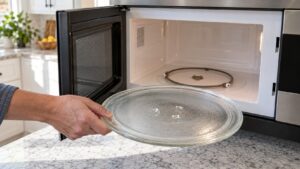

Every ge microwave repair cost estimate starts with the same question: is the failure mechanical or electronic? A stuck turntable and a failed magnetron are both “microwave problems,” but they sit at opposite ends of repair complexity, and understanding that difference explains most of the variation in quotes you will see. We do not publish flat pricing here because it depends on the specific failure, but we can walk through what drives the number up or down.
Mechanical Failures Are the Simple End
Issues like a worn drive coupler, a cracked roller guide, or a stuck door latch are inexpensive parts and straightforward labor. These jobs tend toward the lower end of cost because there is no risk to the technician and no specialized discharge procedure required — it is closer to general appliance mechanical work than electronics repair.
Electronic Problems Add Diagnostic Time
Touchpad problems like F3 (shorted touchpad) and F10 (shorted touch screen) require isolating whether the problem is the touchpad membrane itself, the ribbon connection to the control board, or the board. That diagnostic step takes real time and skill, which is reflected in the total.
Magnetron and High-Voltage Work Is the Complex End
The magnetron, the high-voltage diode, and the high-voltage capacitor sit behind the most dangerous component in any microwave: a capacitor capable of holding a lethal electrical charge even after the unit is unplugged. Technicians must discharge this safely before touching anything near it. Because of the specialized knowledge and extra time this requires, magnetron and HV component repairs sit at the higher end of ge microwave repair cost, and this is genuinely not a DIY repair under any circumstance.
Sensor failures (F1-F6) in the Middle
Failures across the F1 through F6 range typically point to a specific sensor or its wiring rather than the whole control board, so diagnosis is usually faster than a magnetron issue but still requires opening the cabinet and testing individual components — placing these roughly in the middle of the cost range.
Repair vs. Replace Considerations
Age matters. A microwave already well into its typical 7-10 year service life that needs a magnetron replacement is a different economic decision than a two-year-old unit with a stuck turntable. An experienced technician can give you a repair estimate alongside an honest opinion on whether replacement makes more sense for older units.
What Affects Your Specific Quote
Beyond the failure type, factors include whether OEM or high-quality replacement parts are used, whether the unit is a countertop, built-in, or over-the-range model (OTR units take longer to access), and how straightforward the diagnostic turns out to be once the technician is on site.
Why We Do Not Publish a Flat Price
Any single number we could put on this page would be misleading for most readers, because the true cost driver is which specific part failed, not the fact that “a microwave broke.” Two microwaves with the same symptom on the surface — no heat — can have completely different underlying causes and completely different repair scopes, one a quick sensor swap and the other a full high-voltage section replacement. This is exactly why ge microwave repair cost estimates are given after inspection rather than over the phone.
When to Call a Technician
Any suspected magnetron, capacitor, or persistent electronic problem should go straight to a professional rather than a DIY attempt — see /services/microwave-repair/. For mechanical issues, our turntable parts guide explains what is involved.
Summary
Understanding what drives ge microwave repair cost — mechanical simplicity versus electronic or high-voltage complexity — helps set realistic expectations before a technician arrives. Book a diagnostic visit at /schedule/. Product reference material is available at geappliances.com.