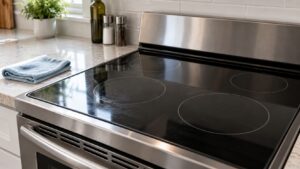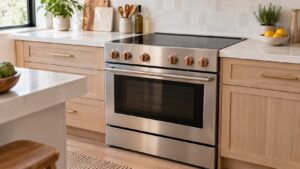
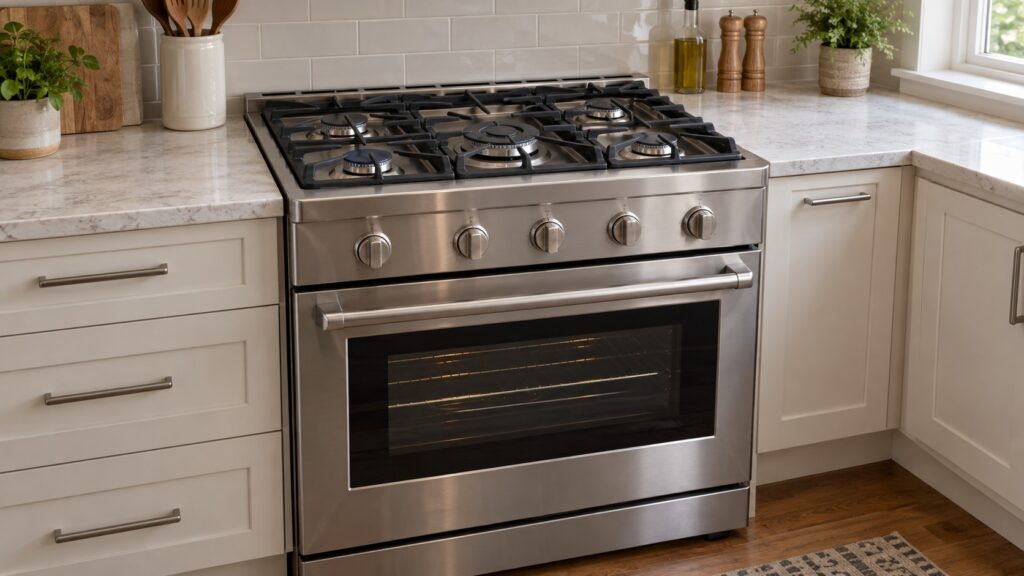
The GE JGB660SEJSS is a 30-inch freestanding gas range with sealed burners, an edge-to-edge cooktop, a Precise Simmer burner, a self-clean oven and a storage drawer. Almost everything that goes wrong with it lands in one of four symptoms, and each of those four has a first test that settles the question in minutes. Work them in order and you will know whether you are looking at a five-dollar blockage or a part.
What kind of range is the GE JGB660SEJSS?
Knowing the architecture makes the tests below make sense. This is a freestanding 30-inch gas range: the four or five cooktop burners are sealed, meaning the burner sits in a welded well rather than over an open drip pan, and each has its own spark electrode. The oven below is gas, self-cleaning, and lit by a glow-bar igniter rather than a spark. There is a storage drawer at the bottom, not a second oven.
The two halves are nearly independent. The cooktop has no display, no sensor and no diagnostic code of its own — it is spark, gas and air. The oven has a control board, a temperature sensor, a door lock and the F-code family. When one half misbehaves and the other is perfect, that is information, not a coincidence.
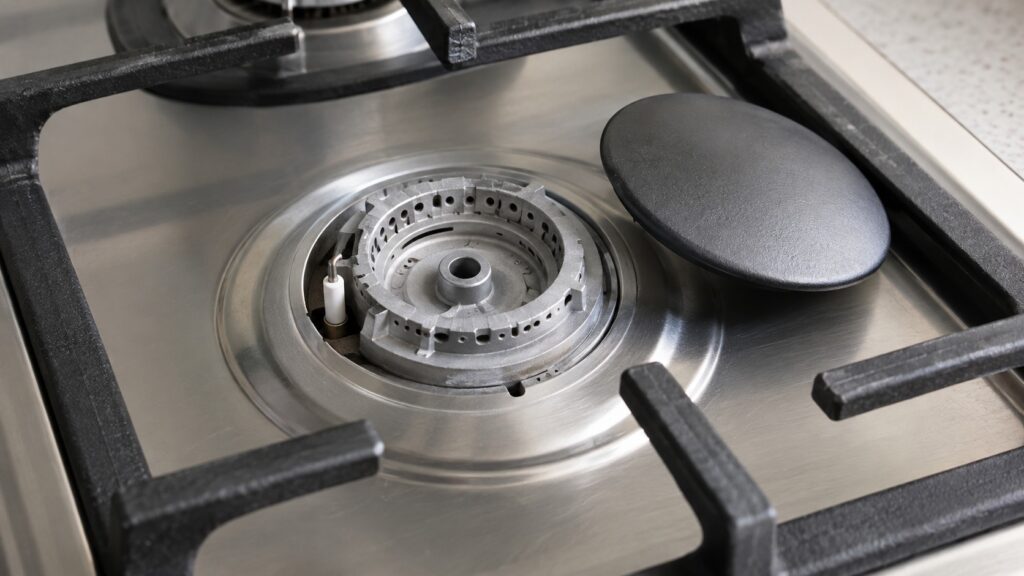
A burner clicks but will not light — what does that mean?
The click is the spark module firing. Hearing it means the ignition system is alive and the diagnosis is already narrowed to gas or geometry.
- Listen to the other burners. On this range, turning one knob makes every electrode click. That is normal and not a fault.
- Lift the burner cap and reseat it. A cap sitting a fraction off its ring puts the flame path out of reach of the spark. This alone fixes a large share of these calls.
- Look at the ports. Boil-over dries into the small holes around the burner ring. Clear them with a straightened paper clip or a stiff brush — never a toothpick, which breaks off inside.
- Dry everything. A burner washed an hour ago will click without lighting until the electrode and the well are fully dry.
If the burner still refuses after that, the electrode or the spark module is next, and that is a job for someone with the range pulled out and the gas shut off. Our guide to a GE gas range igniter that will not light covers the symptom across models, and the igniter and spark module guide covers the parts themselves.
Why does the clicking never stop?
Continuous clicking with every knob off is the one cooktop symptom that alarms people, and it is almost always water rather than electronics. Moisture bridging an electrode to the burner well makes the module see a demand that nobody made.
Turn every knob firmly to off, then check that each one is actually seated — a knob pushed back on slightly crooked can hold its switch just off center. Dry the cooktop surface and the wells thoroughly, and leave the range alone for an hour; after a spill or a clean, most cases stop on their own as the wells dry out.
If the clicking continues on a dry cooktop, switch the range off at the breaker and stop there. A module that fires with no demand will keep firing, and the fix is at the electrode harness. The symptom page for a GE gas burner that clicks continuously has the rest of the detail.
Why is one burner’s flame weak or yellow?
Judge a burner against its neighbors, never against memory. A healthy sealed burner on this range shows a crisp blue crown with small even cones and no lift.
- Yellow and lazy across the whole ring points at air, not gas — usually a cap seated wrong so the mixture is starved. Lift it, clean the rim, and set it down square.
- One dead segment of the ring is a blocked port, and the paper-clip treatment applies.
- Every burner low at once is a supply question, not a burner question. That is the point to check whether the range was converted for propane and never converted back.
- A simmer burner that will not go low is normal behavior misread: the Precise Simmer burner on the JGB660SEJSS is designed to hold a much lower flame than the others, and on the bigger burners the lowest setting is genuinely higher.
The cooktop works but the oven will not heat — what does that point at?
This is the most common oven fault on a gas range of this type, and the test is a stopwatch and a look.
Set a bake temperature and watch the igniter through the bottom of the cavity. It should glow bright within a minute or so, and the gas valve should open and light a flame shortly after. A glow-bar igniter opens the valve by drawing current, and it weakens as it ages: it still glows, but it no longer pulls enough current to open the valve. That is why the classic symptom is an oven that glows for several minutes and never lights, and why a glowing igniter is not proof of a working one.
Time it. Under about 90 seconds from glow to flame is healthy. Three or four minutes with a glow and no flame is a failing igniter, whatever it looks like. Intermittent — fine when cold, refusing after a self-clean cycle — is the same part at an earlier stage.
What do the F codes on this range mean?
The oven side of the JGB660SEJSS reports in the same F-code family as GE’s wall ovens. The cooktop side never shows a code at all, which is why a cooktop complaint is always diagnosed by symptom.
F0, F1, F6 and F7 are keypanel faults — a stuck touch button or a panel the control cannot read. F3 and F4 are the oven temperature sensor, open or shorted. F9 and FC are the door-lock circuit, which is also why a self-clean cycle can end with a door that will not release. F2 and F20 are different in kind: they report an over-temperature condition in the cavity, they are safety-critical, and the correct response is to disconnect power and stop using the oven until it has been looked at. The whole family is laid out in our roundup of GE oven F codes.
What is safe to do on a gas range, and what is not?
Everything above — lifting caps, clearing ports, drying wells, seating knobs, timing an igniter — is safe with the range in place and the gas on. None of it requires tools beyond a brush.
Stop before the back panel, the manifold, the gas line and the oven bottom. A gas connection that has been disturbed and not leak-tested is a hazard that gives no warning, and the oven igniter sits in the gas path by design. If you smell gas at any point, do not test switches or light anything: turn the supply off at the valve behind the range, open a window, leave, and call from outside.
When the checks run out, a visit starts from a standard diagnostic call and the estimate is confirmed before any part is fitted. We are an independent repair company, not a factory service arm. The full specification entry is at our GE JGB660SEJSS page, and the nearby JGBS60REKSS and JGB735SPSS share this diagnosis almost exactly — the JGB735SPSS adds convection and air fry, so it has a fan and a fan motor the JGB660SEJSS does not. For hands on the appliance, see GE range repair, schedule a visit or call (844) 524-4561.