
Most microwave repair calls trace back to a handful of neglected maintenance items, which is why a little routine ge microwave maintenance goes a long way toward avoiding a service visit altogether. None of this requires special tools, and most of it takes only a few minutes a month.
Door Seal and Interlock Care
The most consistently useful piece of ge microwave maintenance is also the simplest: keeping the door seal and the interlock switches behind it clean. Both are safety-critical — they confirm the door is fully closed before allowing the magnetron to fire. Food splatter and grease buildup along the door edge can prevent the door from seating properly, which either stops the unit from starting at all or, in rare cases, triggers a problem. Wipe the door gasket and the cavity front frame with a damp cloth regularly, and never force a door shut that is not latching normally — that is a sign the interlocks need attention, not more force.
Grease Filter Cleaning on OTR Units
Over-the-range microwaves double as range hoods, pulling cooking grease through a filter mounted on the underside. This filter clogs faster than most people expect, especially in kitchens that fry or sauté often. A clogged grease filter reduces exhaust performance and, over time, lets grease residue drift into the cavity vents. Most metal mesh filters can be washed in warm soapy water or run through the dishwasher — check your model’s manual for the recommended interval, generally monthly under normal use.
Turntable and Roller Guide Upkeep
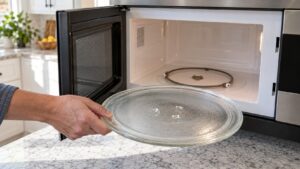
The tray, roller guide, and drive coupler collect spills that eventually gum up rotation. Wash the tray and roller ring regularly and dry them fully before replacing them, since trapped moisture can encourage the roller wheels to stick. For a deeper look at these parts, see our turntable parts guide.
Cavity and Vent Care
Wipe the interior after any spill-heavy use, particularly around the top vent openings where steam escapes — buildup here can affect airflow sensing on smart models. Keep the exterior vent grilles free of dust, and never block the top or side vents with items stored on top of the unit.
Sensor and Touchpad Awareness
Because touchpad failures (see our error code coverage on F3 and F10 problems) are often accelerated by moisture intrusion from cleaning sprays applied directly to the control panel, spray cleaner onto a cloth first rather than onto the panel itself. This single habit meaningfully extends touchpad life. It is also worth avoiding abrasive scrub pads on the touchpad surface, since scratching the printed lettering can make buttons harder to read accurately over time Staying on top of ge microwave maintenance in this way is the simplest thing an owner can do to avoid an avoidable service call.
Building a Simple Monthly Routine
Most owners find it easiest to fold microwave upkeep into an existing kitchen cleaning routine rather than treating it as a separate chore. Wiping the door seal, washing the tray and roller guide, and checking the OTR grease filter can all happen in the same few minutes once a month, and doing them together makes it far more likely the habit actually sticks. Households that cook heavily with oil or fry frequently should shorten that interval, since grease accumulates noticeably faster under those conditions than in a typical kitchen.
When to Call a Technician
If maintenance does not resolve a persistent odor, a door that will not latch, or reduced heating performance despite a clean cavity, it is time to bring in an experienced technician rather than keep cleaning around the problem. Book through /services/microwave-repair/ for a proper diagnostic.
Summary
Consistent ge microwave maintenance — clean door seals, a washed grease filter, a clean turntable assembly, and careful cleaning habits around the touchpad — prevents most of the failures that lead to a service call. Our independent GE appliance repair team is available at /schedule/ when maintenance is not enough. Reference manuals and filter part numbers are available at geappliances.com.