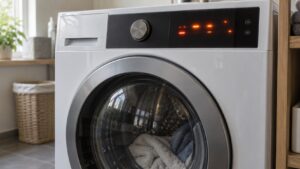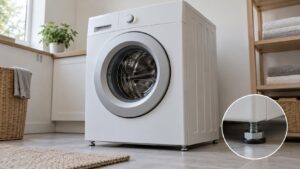
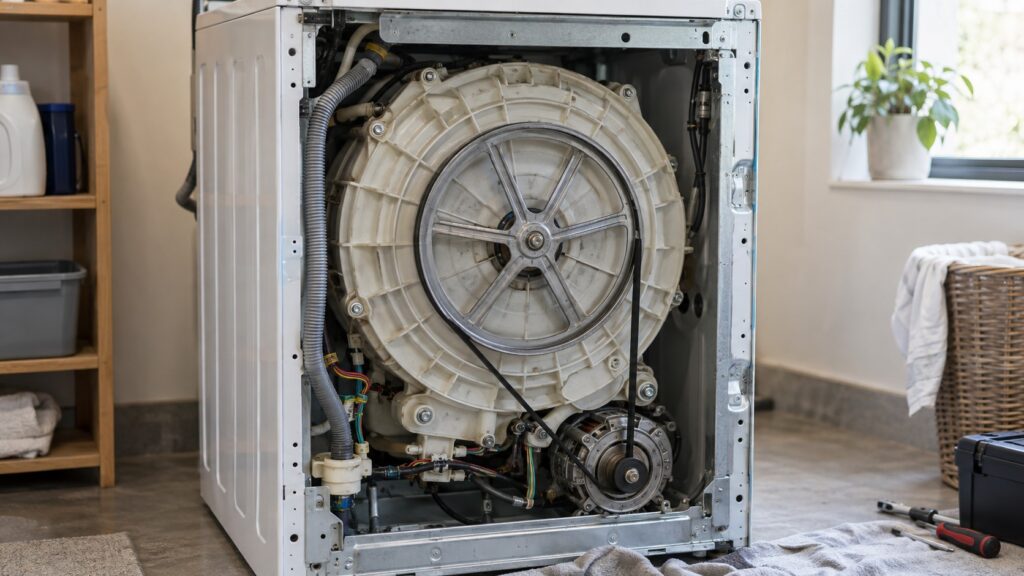
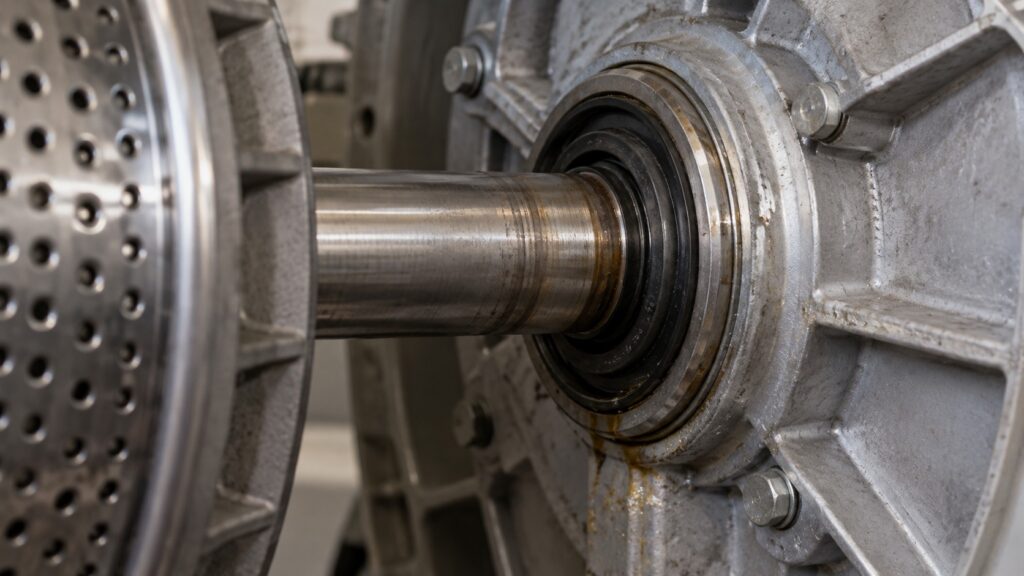
A GE washer tub bearing and its neighboring seal support the inner drum and keep wash water out of the motor housing behind it. When either one wears out, the washer keeps running — it just gets louder on spin, and eventually starts leaking from a spot that has nothing to do with the door boot or the drain hose. Both parts sit on the back of the outer tub, and on most GE models they are sold and replaced as a single sealed assembly rather than separately.
What does a failing tub bearing sound like on a GE washer?
A worn bearing produces a low growl or rumble that starts around mid-spin speed and gets noticeably louder as the drum accelerates toward its final spin. It is different from the rhythmic thumping of an unbalanced load — bearing noise is a continuous grinding or roaring sound rather than a periodic thump, and it does not go away when you redistribute the laundry evenly in the drum. Left running, a bearing that has started to fail rarely gets better; the noise typically increases over weeks as the bearing continues to wear.
What does a failing tub seal look like, versus a door boot leak?
A tub seal leak shows up as water under the machine that appears mainly during or right after the spin cycle, when centrifugal force pushes water against the seal hardest. That is a useful distinction from a door boot leak, which usually shows water pooling during the wash or rinse fill instead. If you see water only after spin and the door gasket looks intact with no visible tears, the tub seal behind the drum is the more likely source, not the door.
Why are the bearing and seal usually replaced together?
On most GE front-load washers, the bearing and seal are pressed into the same housing at the back of the outer tub, and the parts are sold as a combined kit rather than as individual pieces. Once a bearing has failed enough to make noise, the seal next to it has usually already been exposed to the same wear conditions — heat, spin cycles and years of moisture — so replacing only one and leaving the other is rarely worth the labor involved in getting back into that area a second time.
Is this a repair you can do yourself?
It is one of the more involved jobs on a front-load washer. Reaching the bearing and seal means removing the drive belt, the motor, and in many cases splitting the outer tub housing to access the rear of the drum — not a job that opens up from the front panel like a drain pump filter does. The parts themselves are not expensive, but the labor and the risk of misaligning the tub on reassembly are why this repair sits closer to “book a technician” than “weekend project” for most owners.
Reassembly is where a self-repair most often goes wrong: the two tub halves have to seat evenly all the way around, or the machine will vibrate and leak from the seam itself rather than from the bearing area that was just replaced. A shop that does this repair regularly has the clamps and the experience to seat the tub correctly the first time, which is a large part of what the labor charge actually covers. Some shops will also check the shock absorbers and suspension rods around the tub while it is already open, since those parts see the same years of vibration and are far cheaper to swap while the cabinet is already disassembled than to revisit later.
How does this compare to a straightforward drain problem?
A tub bearing or seal issue is mechanical wear inside the drum assembly, not a blockage anywhere in the water path. If the washer is leaking but you have not ruled out the simpler causes first, check the drain hose connection and the door boot before assuming the bearing is at fault — our guide to GE washer not draining covers the water-path side of a leak, which is worth eliminating before opening up the tub. A growling noise on spin with no leak yet is the earlier sign of the same wear and is worth addressing before the seal follows the bearing.
Does load size or an unbalanced wash speed up bearing wear?
Consistently overloading the drum, or washing single heavy items like a comforter or a rug without a balancing counterweight in the load, puts more side load on the bearing every time the machine reaches high spin speed. That extra stress does not cause a bearing to fail on its own, but it shortens the life of a bearing that would otherwise run for many years without issue. A machine that regularly triggers an unbalanced-load pause during spin is putting repeated stress cycles on the same bearing and seal, which is one reason two washers of the same age and model can wear at very different rates. Washing a single bulky item like a comforter with a couple of towels added for balance, rather than alone, spreads that load more evenly across the drum and takes some of the strain off the bearing on every high-speed spin.
Can a bearing or seal problem damage other parts if it’s ignored?
Yes. A seal that has started leaking lets wash water reach the motor housing and the electrical connections around it, and water in that area can take out the motor or the control board long before the original leak would have cost much to fix on its own. A bearing left to grind for months can also chew into the shaft it rides on, turning what started as a bearing-and-seal kit replacement into a shaft or drum replacement instead. Neither failure mode improves with time, which is the main reason to treat an early growl or a first small puddle as worth scheduling rather than monitoring for a few more months.
When should a tub bearing or seal go to a technician?
Once the noise is present on every spin cycle, or water has started appearing after spin, the part is not going to recover on its own. A visit starts from a standard diagnostic call and the estimate is confirmed before any part is ordered — we are an independent repair company, not a factory service arm, and on an older washer we will tell you plainly when the labor to reach this part costs more than the machine is worth to keep running.
For the routine care that slows wear on this part, see our GE washer maintenance guide. GE washer repair covers a worn tub bearing or seal, and you can schedule a visit or call (844) 524-4561 with the sound or the leak pattern described.