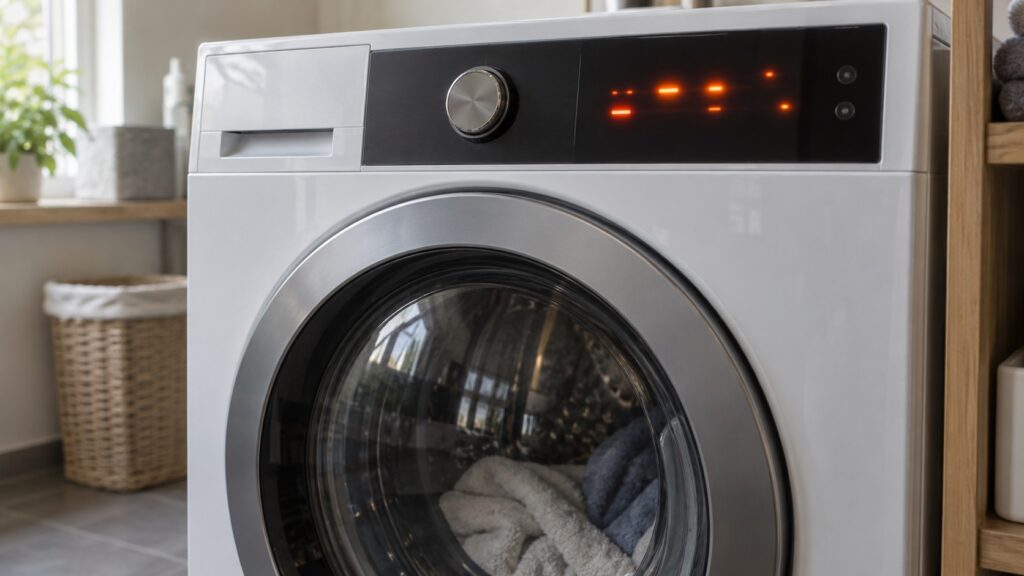
The GE washer display codes covered here are E22, E23 and E45. E22 means the washer could not finish filling in time, E23 means it could not drain in time and E45 means the door lock was flagged during an overload. They apply to GE washers with an electronic display. Mechanical-dial GE top-loaders have no codes and are diagnosed by symptom. A code that is not covered here is one to read in your owner’s manual, or to bring to a technician.
What does E22 mean on a GE washer?
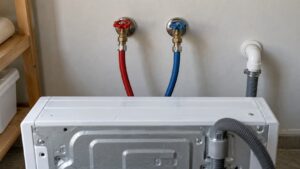
Our E22 page describes it as a reported fill-timeout problem: the washer could not complete filling within its expected window. The page lists the water inlet valve, the inlet hoses, the inlet screens and household water pressure. Check that both water taps are fully open, that the hoses are not kinked and that the supply is working. A hose screen full of grit or a closed tap is a common reason. Our GE washer E22 guide goes through the checks, and the page rates the repair as DIY-friendly for the first steps.
What does E23 mean?
Our E23 page describes a drain-timeout problem: the washer could not drain within its expected window and engaged a protective response to avoid overflowing. It lists the drain pump, the drain hose and the drain filter. A clogged filter or a kinked hose is the first thing to look at, and the owner’s manual shows where the filter is on your model. Do not open the cabinet. Our E23 guide and drain pump filter cleaning guide give the steps, and our washer not draining guide is the next stop.
What does E45 mean?
Our E45 page says the control detects the door as locked while also flagging an overload condition. It lists the door lock assembly, the door switch and the wiring harness. An oversized or unbalanced load is a sensible first suspect: take out some items, spread the load and try again. Our E45 guide has the detail. Do not force the door open against the lock.
Which checks can you start on yourself?
Our pages rate the first steps for E22, E23 and E45 as DIY-friendly, and those steps are the ones outside the machine: the taps, the hoses, the filter, the load size and the door. Work through them in that order and try one cycle after each fix, so that you know which one helped. If the code returns, or the washer shows any code this page does not cover, stop. Note the code, switch the washer off and call a technician, and do not run it repeatedly, because repeated runs with a motor or control fault can make it worse. If water is on the floor near an outlet, or you see sparks or smell burning, switch off the breaker at the panel while standing on a dry floor, and never pull a plug from a wet outlet.
How does the load affect these codes?
On our page E45 is tied to an overload. A load that is too big, too heavy or lumped to one side strains the drive system, and the control reacts. That is why the first sensible check for E45 is the load: take out some items, spread the rest around the drum and try again. Heavy items such as bedding and rugs absorb a lot of water and become far heavier than they look, so wash them in smaller amounts. Our washer won’t spin diagnostic explains how the washer decides whether a spin is safe. A code that returns with a small, balanced load is a different matter and needs a technician.
Fill and drain codes depend on the house as much as on the washer. A fill timeout can come from a tap that is partly closed or a supply with low pressure, and a drain timeout can come from a standpipe that is blocked or a hose pushed too far down it. Look at those before you suspect the machine, and note them for the technician if you call.
What should you tell the technician?
Write down the exact code and when it appeared: while the washer was filling, while it was draining or when you tried to open the door. Note how big the load was, whether the taps were fully open and whether any water was left in the drum or on the floor. Have the model and serial number ready, which your owner’s manual shows how to find, and say whether the washer is a front-load or a top-load model. Do not force a locked door open, and do not reach into the drum if water is still in it. With those details a technician can bring the right part on the first visit and can tell a house problem, such as a closed tap or a blocked standpipe, from a fault in the washer.
What if there is no code?
Our site has symptom pages for GE washers that show no code, including a washer that is not filling, not draining, not spinning or shaking badly. Our washer not spinning guide and diagnostic mode guide are good starting points, and our error codes by appliance guide lists codes across GE appliances. Our GE washer repair page explains how a visit works.