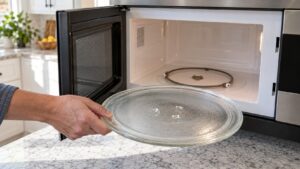
A ge microwave f1 f2 code appears on GE’s over-the-range and countertop microwave models when the thermal sensor – which monitors internal cavity temperature for safety – reads outside the range the control board expects. GE lists both codes in its own official problem documentation for the microwave platform, and like the oven’s temperature sensor codes, F1 and F2 represent the same failed component read in two different electrical directions.
What F1 means
F1 indicates an open thermal sensor circuit – the sensor or its wiring has lost continuity, so the control board cannot get any temperature reading from that circuit at all.
What F2 means
F2 indicates a shorted thermal sensor circuit – the sensor or its wiring is reading a resistance far lower than it should, which the control board interprets as an electrical problem rather than a genuine temperature reading.
What causes thermal sensor failure
- Age-related wear on the sensor after years of heat cycling near the magnetron and cavity
- A damaged or corroded connector at the sensor harness
- A broken wire in the sensor circuit, sometimes from vibration during door use
- Excess heat exposure from grease buildup restricting normal airflow around the cavity
Other GE microwave codes worth knowing
The thermal sensor family sits alongside several other documented microwave error codes: F3 for a shorted touchpad, F4 and F5 for open and shorted humidity sensors, F6 for a shorted temperature probe, F10 for a shorted touch screen on models with that feature, and a distinct “Probe” message for an open or unplugged meat probe. Separately, 888, 8888, or PF on the display simply means the clock reset after a power interruption – not a problem at all.
What to do first
- Note whether the display specifically shows F1 or F2, since it confirms which direction the sensor failure is reading
- Unplug the microwave for a minute and restart to confirm the code is persistent rather than a momentary glitch
- Check that the vents around the microwave, especially on over-the-range models, are not blocked by grease buildup
- Avoid continuing to use the microwave if the problem persists, since a genuine sensor failure means the control cannot reliably monitor internal temperature
When to call a technician
Confirming a thermal sensor failure requires testing the sensor’s resistance against the manufacturer’s expected value, and this sits inside the same cavity area as high-voltage components, so it is not a repair to attempt without the right training. Our microwave repair technicians can test the sensor circuit safely and confirm the problem before replacing anything. If your microwave has stopped heating altogether rather than showing a specific code, our microwave not heating guide covers the broader set of causes.
Why microwave repairs deserve extra caution
Microwaves store high voltage in their internal capacitor even after being unplugged, which is one of the clearest reasons this appliance category is best left to a trained technician for anything beyond checking the vents and power cycling.
Quick summary
A ge microwave f1 f2 code nearly always points to the thermal sensor circuit, in either an open or shorted state, and a technician can confirm which safely with the proper test equipment before any part is replaced.
Why grease buildup deserves attention here too
Because heat and airflow around the cavity affect how the thermal sensor behaves over time, keeping the vents on an over-the-range microwave clear of grease is one small habit that can delay the onset of a ge microwave f1 f2 code, even though the sensor itself will eventually wear out from age regardless of how well the unit is maintained, since a ge microwave f1 f2 code is ultimately a wear-and-tear outcome rather than a defect.
Our experienced, independent technicians safely diagnose and repair GE microwave sensor failures using OEM or high-quality replacement parts. Schedule service at /schedule/. For general product information, visit geappliances.com.