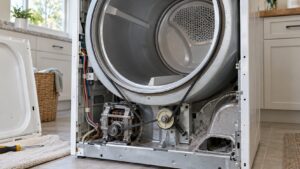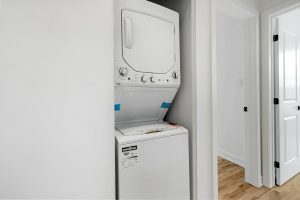
A ge dryer wont heat diagnostic flow is most efficient when it follows the actual chain of cause and effect rather than jumping straight to the heating element or igniter. In a large share of no-heat calls, the true root cause is a blocked exhaust vent that has already blown a safety fuse further downstream, which means replacing that fuse without clearing the vent just leads to a repeat failure within a few cycles.
Step 1 – Check the exhaust vent path
A dryer tumbling normally but producing no heat, combined with unusually long dry times or a hot exterior cabinet, points strongly toward restricted airflow. Disconnect the exhaust duct at the back of the dryer and check for lint blockage along its full length to the exterior vent cap, since even a partial restriction raises internal temperature enough to trip safety devices.
Step 2 – Test the thermal fuse
If the vent was blocked, the thermal fuse has very likely already blown, since it is specifically designed to sacrifice itself when airflow restriction pushes internal temperature past a safe limit. See our related guide on the GE dryer thermal fuse and thermistor for how to test it with a multimeter – a blown fuse reads as an open circuit (no continuity) and must be replaced, not reset.
Step 3 – Isolate by fuel type
For an electric GE dryer, check the heating element for continuity and inspect it visually for a visible break or burn mark. For a gas GE dryer, confirm the gas supply valve is fully open, then check the igniter – a healthy glow-bar igniter should glow, draw increasing current, and open the gas valve within a matter of seconds; one that glows but never gets hot enough to open the valve needs replacement.
Step 4 – Check for an active error code
Electronic-control GE dryers may display E1 (thermistor failure), E2 (high-limit tripped), or E3 (exhaust over-temperature) – all three of these point back toward the same vent-and-heat-path chain covered in steps one through three, so a code display can actually confirm which stage of this flow to focus on first.
Step 5 – Rule out the gas supply itself, if applicable
On gas dryers, also confirm the gas valve coil (separate from the igniter) is opening properly when energized, since a working igniter paired with a stuck-closed gas valve produces the same no-heat symptom.
When to call a technician
Our dryer repair technicians always clear the vent path before replacing a blown thermal fuse, since skipping that step means the new fuse is likely to blow again on the very next few loads.
Why a proper ge dryer wont heat diagnostic flow saves a repeat service call
Skipping straight to a heating element or igniter replacement without confirming vent airflow first is the single most common reason a dryer repair does not stick – a new element or igniter behind a still-restricted vent runs hotter than it should and can trip the same fuse again within weeks. A complete ge dryer wont heat diagnostic flow treats the vent check as mandatory, even when a blown fuse or failed element seems like the obvious answer. Vent length, elbow bends, and ducting material (rigid metal outperforms foil or plastic accordion duct, which sag and trap lint) all affect how quickly a vent restricts again after cleaning, so a technician also evaluates the duct run itself, not just the immediate blockage.
A quick homeowner test between service visits
Feel the outside vent cap while a load is running – strong, steady airflow is a good sign, while weak airflow suggests a restriction along the duct run even if the dryer’s interior looks clear. This check is worth doing before starting any ge dryer wont heat diagnostic flow, since it tells you whether to focus on the vent or the heat source.
Quick summary
Checking the vent path first, before any part replacement, resolves or explains the majority of no-heat dryer complaints and prevents a repeat failure of a newly replaced thermal fuse.
Our experienced, independent technicians – not affiliated with GE Appliances, a Haier company, or General Electric Company – follow this vent-first diagnostic sequence on every no-heat call. Schedule service at /schedule/. General GE product information is at geappliances.com.