The ge dryer thermal fuse and the thermistor are often confused because both sit near the heat source and both relate to temperature control, but they serve very different purposes. The thermal fuse is a one-time safety device: once it blows from excessive heat, it must be replaced – it cannot reset itself. The thermistor, by contrast, is a resistance-based temperature sensor that the control board reads continuously and reuses cycle after cycle to regulate heat.
How the ge dryer thermal fuse works
The thermal fuse is wired in series with the heating circuit and is designed to permanently open if the airflow through the dryer becomes restricted enough that internal temperatures spike beyond a safe limit – almost always caused by a clogged or blocked exhaust vent. Once blown, the dryer will run but produce no heat at all, since the fuse has physically broken the circuit. See our related guide on GE dryer E3 code, which covers the electronic-control version of this same overheat protection on newer models.
How the thermistor works
The thermistor is a small sensor, typically mounted in the airflow path near the heating element or exhaust duct, whose electrical resistance changes predictably with temperature. The control board reads that resistance continuously and cycles the heating element on and off to hold the target temperature for the selected cycle. Because it is reusable and simply reports a value, a failing thermistor tends to cause erratic heat – too hot, too cool, or a dryer that runs a full cycle without ever really drying clothes – rather than a complete loss of heat.
Why vent blockage matters to both parts
A restricted exhaust vent is the single most common root cause behind both a blown thermal fuse and a thermistor reading abnormally high temperatures, because trapped hot, moist air has nowhere to go and keeps raising the internal temperature well past normal operating range. Replacing a blown thermal fuse without also clearing the vent almost guarantees the new fuse will blow again within a few cycles.
Symptoms to watch for
- Thermal fuse blown: dryer runs, tumbles, and makes noise, but produces zero heat
- Thermistor failing: clothes come out too hot, too damp, or drying times become inconsistent
- Either: a burning smell, unusually hot exterior cabinet, or an unusually long drying time
When to call a technician
Because a blown ge dryer thermal fuse is almost always a symptom of a deeper vent problem, our dryer repair technicians always check and clear the exhaust vent path when replacing one, rather than simply swapping the part and sending you on your way. A thermistor replacement is tested against known resistance values to confirm the sensor itself, not the control board, is responsible.
The high-limit thermostat and cycling thermostat
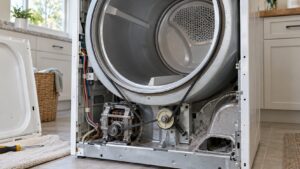
Beyond the ge dryer thermal fuse and thermistor, most GE dryers also include a high-limit safety thermostat and, on some designs, a cycling thermostat, all mounted on or near the heater housing. The high-limit thermostat is a resettable backup that trips before the one-time thermal fuse does, cutting heat if the temperature climbs too high from restricted airflow. Because these parts sit in the same airflow path and share the same root cause – a blocked vent – a technician testing a no-heat dryer checks the thermal fuse, high-limit thermostat, and thermistor together rather than in isolation. On electric models these safety parts cluster around the heating element housing at the back of the cabinet, while on gas models they sit near the burner assembly behind the front panel. Knowing where they live speeds up the diagnosis considerably, and it explains why an accurate repair looks at the whole heat-and-airflow chain instead of swapping a single part and hoping.
Quick summary
A dryer with zero heat points toward a blown thermal fuse and a blocked vent, while a dryer with inconsistent or wrong heat points toward a failing thermistor – either way, checking the vent path is the first and most important step before replacing parts.
Our experienced, independent technicians – not affiliated with GE Appliances, a Haier company, or General Electric Company – diagnose and replace both parts correctly, and always check vent airflow. Schedule service at /schedule/. General GE product information is at geappliances.com.