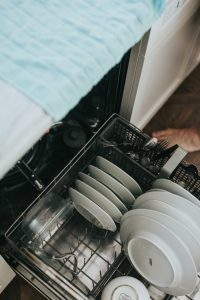
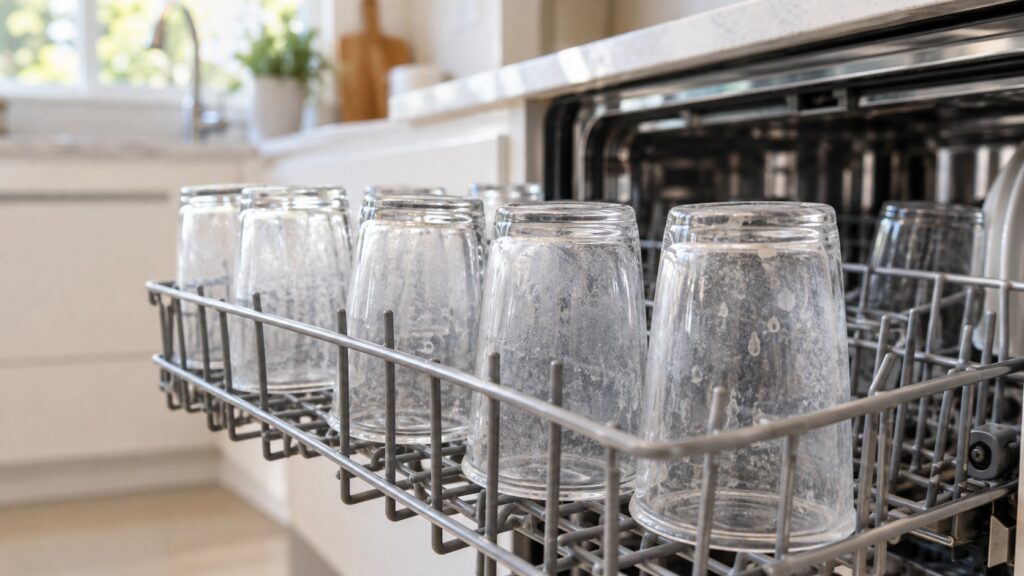
If your glasses come out of the dishwasher cloudy and your plates feel gritty, the machine is probably fine. GE dishwasher hard water problems look like a cleaning failure and are a water chemistry problem, and the distinction matters because no amount of stronger detergent fixes the second one — while several common responses to it make things worse.
Film or etching: find out which you have
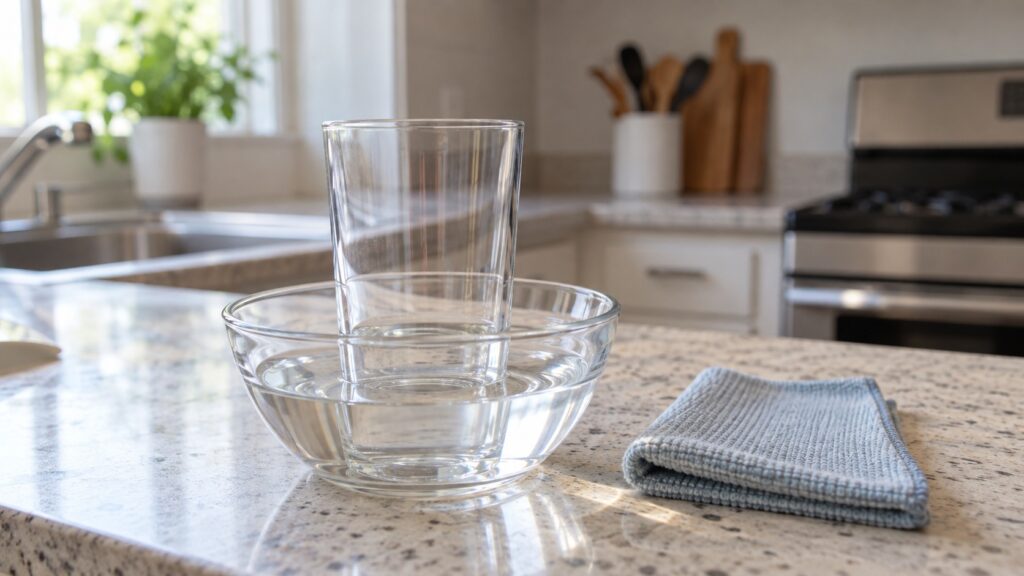
These look identical and have opposite causes. Take a cloudy glass and soak it in white vinegar for a few minutes, then rinse. If it comes out clear, you had mineral film from hard water. If it stays cloudy, the glass is etched — microscopic damage to the surface — and nothing will restore it.
The reason this matters is that the two need opposite responses. Film means more help for the detergent: rinse aid, correct dosing, hotter water. Etching means less — it is caused by excessive detergent in soft water, by very hot cycles on delicate glass, or by both. Treating etching as film and adding more detergent destroys more glassware.
Rinse aid is not optional in hard water
Rinse aid does one thing: it changes how water behaves on a surface as it dries. Without it, water beads, and each bead dries into a spot of whatever minerals it was carrying. With it, water sheets off and takes the minerals with it. That is the entire mechanism, and it is why rinse aid makes a larger visible difference in a hard-water area than any detergent choice.
Keep the dispenser topped up, and check the setting — most machines have a dosage adjustment, and the factory setting is chosen for average water. If glasses are spotted, turn it up one step and give it a week. Our page on poor cleaning covers what else produces a similar complaint.
Detergent: more is not better
- Dose for your water, not for the scoop. In soft water a full dose is too much and etches glass; in hard water it may be too little.
- Powder is adjustable, tablets are not. In very soft or very hard water a powder gives you a lever that a tablet does not.
- Do not add extra to fight film. Add rinse aid and heat instead — detergent is not what removes minerals.
- Store it dry. Detergent that has absorbed moisture clumps and doses unevenly.
Scale on the heating element is the slow damage
In hard water, minerals deposit on the hottest surface in the machine — the heating element. A scaled element transfers heat poorly, so the machine runs longer to reach temperature, cleans less well, and eventually reports a heating fault on an element that is not broken.
Prevention is a hot cycle run regularly rather than a machine that only ever sees eco programs, plus a descaling product a few times a year in a hard-water area. Household vinegar is a common substitute and a poor one — it is weak for the job and hard on rubber seals over time.
What hard water does to the rest of the machine
Glassware is where you see it, and it is not where the damage is. Scale forms on every hot wet surface: the element, the spray arm bearings, the inside of the circulation pump and the small passages that feed the upper arm. None of that is visible until something behaves oddly — an upper rack that stops being washed properly, a spray arm that no longer spins freely, a cycle that has quietly grown by twenty minutes.
That is the argument for descaling on a schedule rather than when the glasses look bad. The glasses are the early warning for problems that are developing out of sight, and a household that solves the glassware cosmetically with rinse aid alone has silenced the warning without addressing what it was warning about.
Plastics, aluminum and the items that react
Hard water and hot cycles treat some materials badly regardless of how the machine is set. Aluminum pans darken and can develop a chalky bloom — that is a reaction with the detergent rather than the water, and the answer is to wash them by hand. Plastic containers hold water in their rims and dry poorly, which in hard water means every drop leaves a spot.
Two habits help: load plastics on the upper rack angled so water runs off rather than pooling, and take them out last so they get the benefit of the residual heat. Neither cures hard water; both remove the most visible symptom of it.
The checks that come before the water
Before concluding anything about water chemistry, rule out the two mechanical causes that produce similar complaints. A blocked filter recirculates debris and leaves grit on everything — see our filter cleaning guide. And spray arms with blocked holes change the spray pattern, so one part of the load is washed and another is not — see spray arm cleaning.
Both are five-minute jobs and both are far more common than people expect. Do them first; if the complaint survives, then it is the water.
Knowing your water instead of guessing
Water hardness is a number, and your utility publishes it. A test strip is a couple of dollars and settles it in a minute. That number decides the rinse aid setting, the detergent dose and whether descaling is a seasonal job or an annual one — and it turns all of this from trial and error into two decisions made once.
If the number is high enough, treating the supply is more effective than anything done at the appliance, and it helps the washer, the water heater and the coffee machine at the same time.
When it is the machine
Residue appearing suddenly on a program that used to work, water not heating, or a cycle that has become much longer with clean filters — those point at the heater, the thermostat or the circulation pump rather than the water.
We are an independent repair company, not a factory service arm. Pricing starts from a diagnostic visit and we confirm the estimate before any work begins. GE dishwasher repair covers heating, circulation and controls, and you can schedule a visit online. Our dishwasher maintenance guide covers the wider routine.