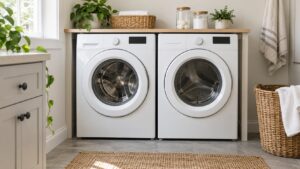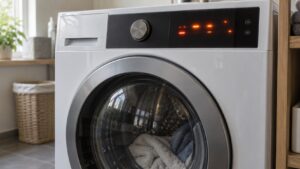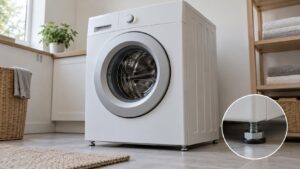
GE washer motor and control fault codes are the three that rarely have a home fix: E30, E42 and E58. On the electronic-control GE washers we service, E30 means the control is getting no signal back from the drain pump, E42 means the drive motor or inverter has detected an overload, and E58 means a failure on the main control. They sit together because each one lives deep in the wiring and electronics of the washer, and because the right response to all three begins the same way: stop, make one clean reset attempt, and avoid running cycle after cycle while the code returns. This guide separates them, shows which one can be a loading problem, and links to the codes that do have simple fixes.
What do GE washer E30, E42 and E58 mean?
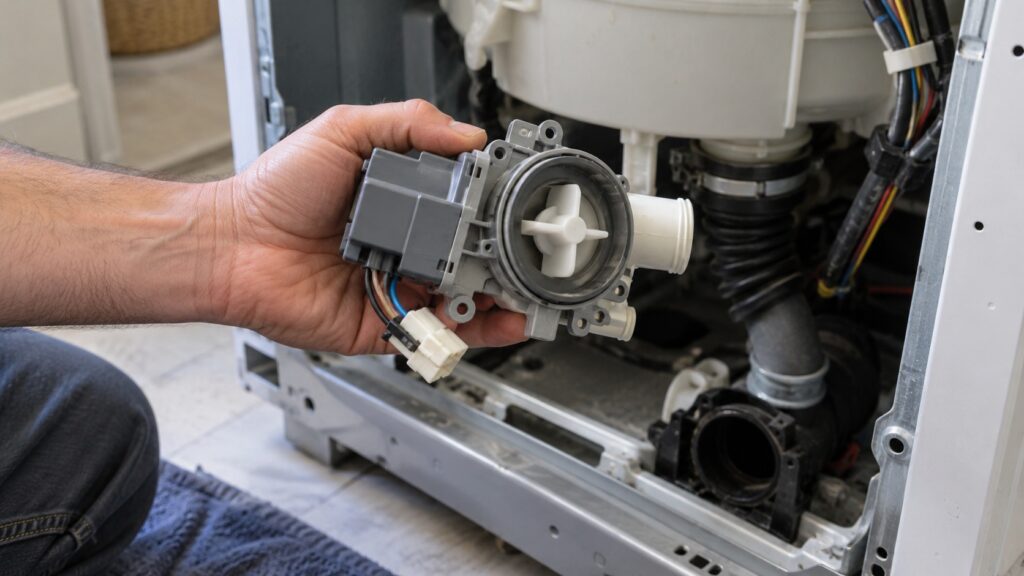
E30 is a no-signal fault from the drain pump. The control is supposed to receive feedback from the pump while it runs, and with E30 it receives nothing at all. That is different from a pump that runs and fails to clear the water in time, which is the E23 code covered in our GE washer E23 guide. With E30 you will usually hear no pump sound at all during a drain attempt, water stays standing in the drum, and the cycle cannot proceed past drain.
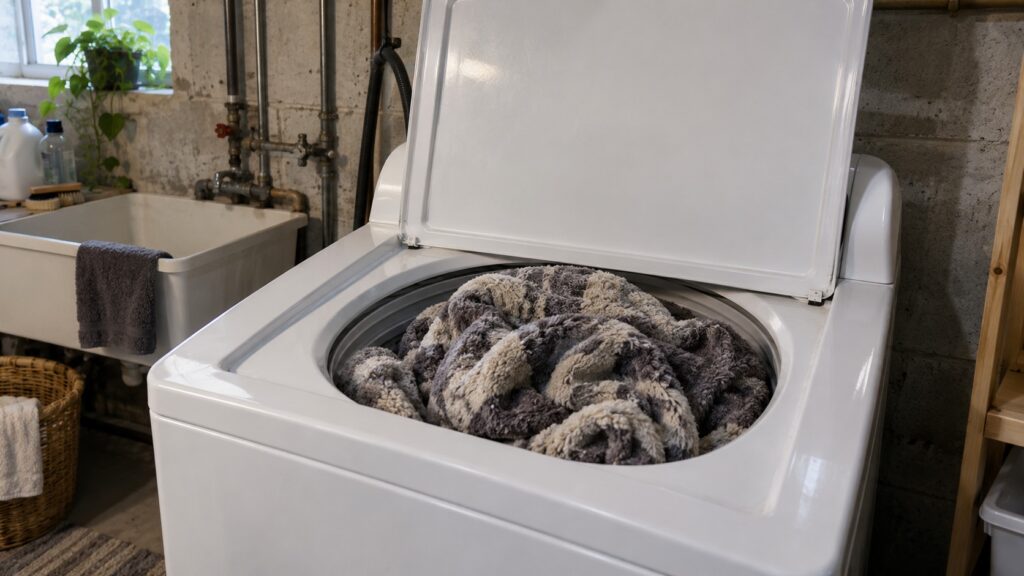
E42 means the drive motor or the inverter board that controls its speed has detected an overload. The usual trigger is a load that is too big or badly unbalanced, such as a single heavy blanket or a rug washed alone, which makes the motor work harder than it can. The wash or spin step stops abruptly, and the drum may feel as if it struggled before it stopped.
E58 is a failure on the main control. It points to a broader board-level problem rather than a single component like the motor or the pump, and it is one of the more serious codes on this platform. The washer may not start, may stop unpredictably, or may behave strangely in several functions at once, and the code returns quickly after a reset.
How do the three differ from E22, E23 and E45?
GE’s electronic washers speak in a short set of codes, and these six are easy to mix up. The ones with a likely home fix are E22, a fill that timed out, which our GE washer E22 guide covers, E23, a drain that timed out and engaged flood protection, and E45, a door that registers as locked during an overload condition, covered in our GE washer E45 guide. E45 shares a root with E42: an overloaded or unbalanced load. If you have both, start with the load.
The three in this guide are different in kind. E30 and E58 tell you that something in the circuit has stopped talking, and the checks you can make are limited to listening, resetting and observing. E42 can often be solved with a smaller load, but if it comes back with a normal load, the motor or the inverter is suspect.
What can you safely try for each code?
- E30. Listen closely during a drain attempt for any pump sound at all. Power-cycle the washer at the breaker and retest once. If there is still no pump sound, stop trying repeatedly.
- E42. Reduce or redistribute the load and restart the cycle. Avoid washing single bulky items such as heavy blankets and rugs alone. Power-cycle the washer and retest with a smaller, balanced load.
- E58. Unplug the washer for a few minutes to force a full reset, plug it back in and start a normal cycle. Do not cycle the power repeatedly in quick succession.
In all three cases, if the code returns, stop and arrange service. Repeated retries on an overloaded motor or a failing board can make the repair bigger. And keep your hands away from the pump and the cabinet while the washer is plugged in; the water and the mains voltage together are why these are technician jobs.
What does a technician test?
For E30, a technician tests the drain pump motor, the wiring harness between the pump and the control board, and the board itself. A harness connector that has worked loose is a cheap fix, a failed pump is moderate, and a board is the most expensive, which is why the order of testing matters. For E42, the technician tests the drive motor and the inverter board, since a failing motor draws too much current and overloads the inverter. For E58, the wiring harness and the main control board are tested, and any damaged connector is repaired before a board is condemned. In each case a genuine OEM part is fitted only against a positive test.
Our model pages note that on GTW top-load washers such as the GTW335ASNWW and GTW680BSJWS, E42 shows up as overload trips, and a locked-door complaint is almost always an overloaded, unbalanced load. That is worth remembering before you assume the motor has failed.
Is it worth repairing the washer?
E30 is often a fair repair, E42 depends on whether it is the load, the motor or the inverter, and E58 is usually a board decision. With an older washer and a board-level fault, compare the repair with the cost of a new machine, and our GE washer repair cost guide helps set expectations. If the washer will not spin for other reasons, our GE washer won’t spin diagnostic goes through the causes. When you are ready for a diagnosis, GE washer repair covers the visit, and we are an independent service, so we will tell you plainly which group your code falls in. You can book a visit online.