
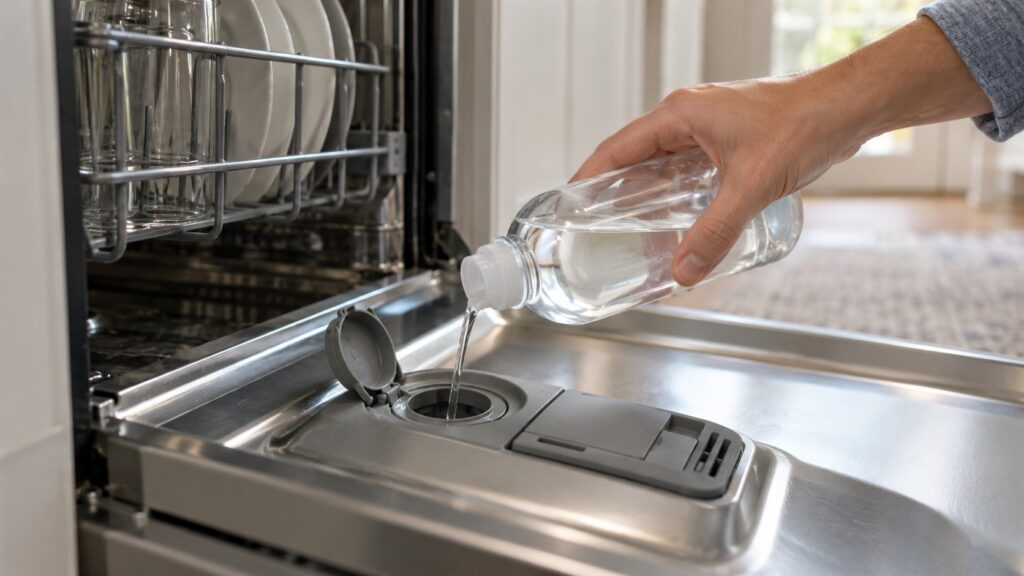
To use rinse aid in a GE dishwasher, open the rinse aid dispenser, pour liquid rinse aid into the reservoir, close the cap firmly and set the dial to the level that gives spot-free glasses. Rinse aid does one thing: it changes how water behaves on a surface as it dries, so water sheets off instead of forming droplets. A reservoir that is empty or a dial set too low is the most common reason dishes come out beaded or spotted, and it is also the easiest cause to rule out. The exact place of the dispenser and the look of the indicator differ by model, so your owner’s manual shows yours.
How do you fill the rinse aid dispenser on a GE dishwasher?
Follow these steps, and check your manual for the exact shape of the cap on your model:
- Make sure the dishwasher is not running, and let the door and tub cool if a cycle just finished.
- Open the door and find the rinse aid dispenser. On many dishwashers it sits on the inner side of the door, near the detergent cup; your manual shows the exact spot.
- Turn the cap and lift it off, then pour the rinse aid in slowly, up to the fill mark the manual describes, and not above it.
- Wipe up any spill with a damp cloth. Spilled rinse aid creates suds in the next cycle and can leave a film.
- Seat the cap and turn it until it is tight, because a loose or leaking cap lets rinse aid escape before the dispenser can meter it.
Use a product made for dishwashers. Do not pour dish soap or home substitutes such as vinegar into the reservoir; use only what the owner’s manual allows. Dish soap produces foam that can overflow the door.
How does the rinse aid indicator and dial work?
The reservoir tells you when it needs a refill, either with a light or a window on the dispenser, depending on the model. Look at the manual for the symbol on your control panel. The dial, or the setting, controls how much rinse aid is released in each cycle. Our page on a GE dishwasher not dispensing rinse aid lists a dial set to the lowest position as one of the common causes of poor results, with the sign that the dial indicator has not moved from its lowest setting. If your glasses are spotted and the reservoir is full, raise the dial a notch and check the results over a few cycles before you change it again.
Do not set the dial to its highest position at once. Too much rinse aid can leave a streaky film and cloudy glasses, and it uses the bottle up faster. Small changes with a few cycles of feedback are the way to find the right level.
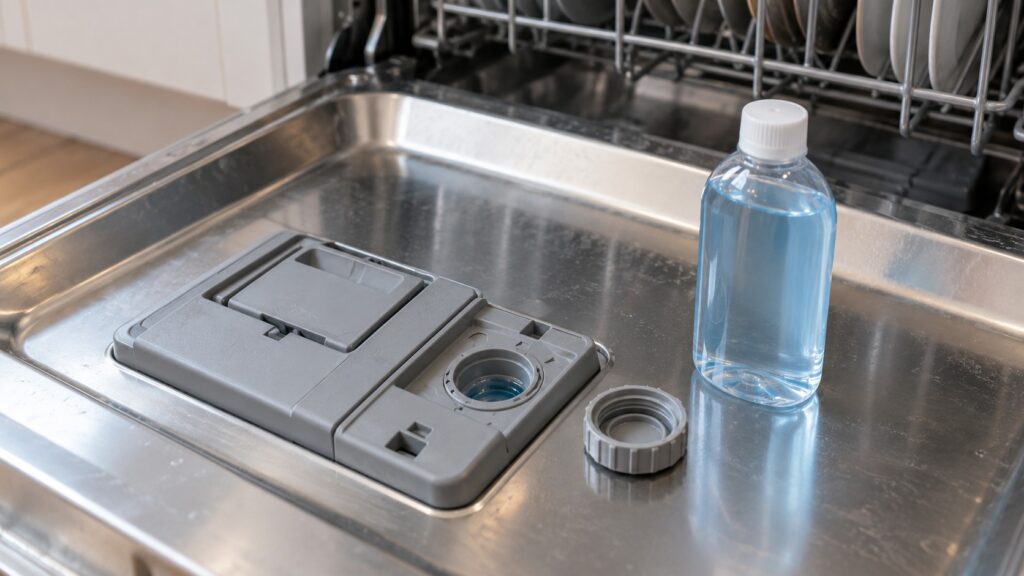
Why is rinse aid not working in your GE dishwasher?
Two different problems get the same label. Either the reservoir barely empties over many cycles, or dishes still dry with spots and droplets even though the reservoir is full. The symptom page lists these causes: a dial set too low, a dispenser door that is stuck, a loose or leaking cap and a wax motor or mechanical latch that is not opening the dispenser door. You can check the first and the third yourself. Make sure the cap is seated and not leaking, turn the dial up one notch, then top the reservoir off, mark the level and see how fast it goes down over a week. A level that never moves while the dishes stay wet means the dispenser is not releasing, and the next step is a technician. Read the full page: dishwasher not dispensing rinse aid.
What if the dishes are still wet after you fix the rinse aid?
Rinse aid is the first thing to check for wet dishes, but it is not the only one. A failed heating element, a vent that does not open, an eco cycle that uses less heat and a load packed too tightly can all leave dishes damp. Select a heated-dry setting if the model offers one, leave space between dishes and prop the door open briefly after the cycle. Our guide to GE dishwasher heated dry problems covers the diagnosis from the drying side, and the dishwasher not drying page lists the same causes in order.
Does hard water change how you use rinse aid?
It can. Hard water leaves spots and a film on glasses more readily, so the rinse aid, the detergent dose and the water temperature all matter; the manual lists the settings for your model. If you see white scale on the tub or the glasses, our GE dishwasher hard water care guide explains what to do, and the GE dishwasher maintenance guide describes the cleaning that keeps the dispenser and the spray arms working. A clogged filter also leaves residue, so check it too.
When should you call a technician?
Call when the reservoir level barely changes over several cycles with the dial turned up, when the cap leaks even after it is seated or when you can see that the dispenser door does not open. Those point to the dispenser door, the wax motor or the latch, and the symptom is low severity, so there is no emergency. If the same problem returns after your checks, a technician should confirm the cause before any part is replaced. Our GE dishwasher repair service can test the dispenser.