
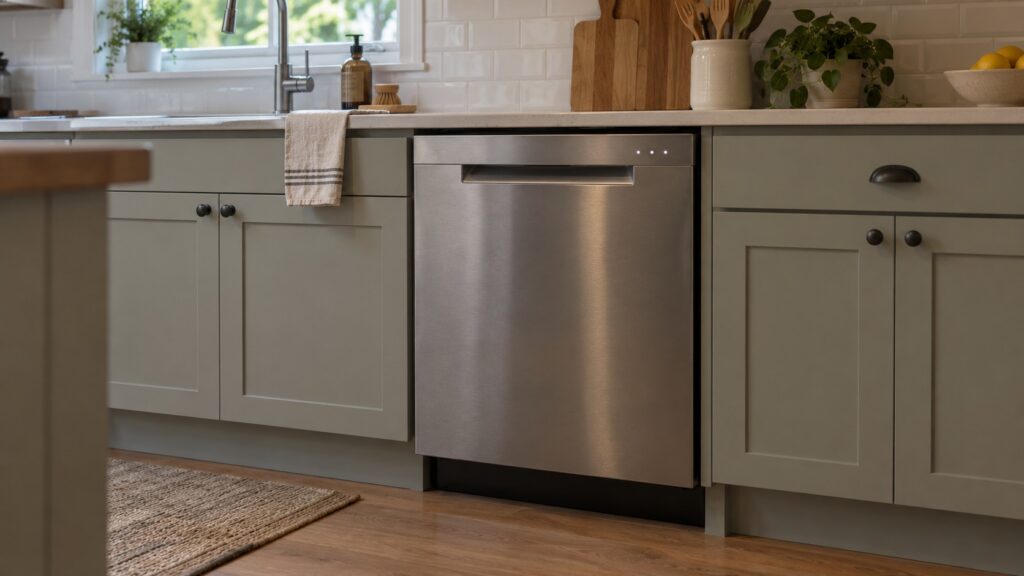
A GE dishwasher not starting is most often a door that does not latch fully, a tripped breaker or GFCI outlet, a delay-start timer that was set by accident, or a locked control panel. Check them in that order, because the first four cost nothing and account for most of the calls. If the door latches, power is confirmed, the delay is canceled and the panel is unlocked, and the dishwasher still will not start, the door switch or the control board needs a technician.
Why won’t my GE dishwasher start?
Because a dishwasher refuses to run unless every safety and power condition is met, and any one missing link looks the same from the front: you press Start and nothing happens. Our symptom page for a GE dishwasher that will not start lists the causes in order of likelihood: the door is not latching fully, a breaker or GFCI outlet has tripped, a delay-start has been set, the control lock is on, or, less commonly, the control board has failed. The door comes first because the door switch is a safety interlock, so a door that is not latching fully will silently block every start attempt.
Step 1: Does the door latch properly?
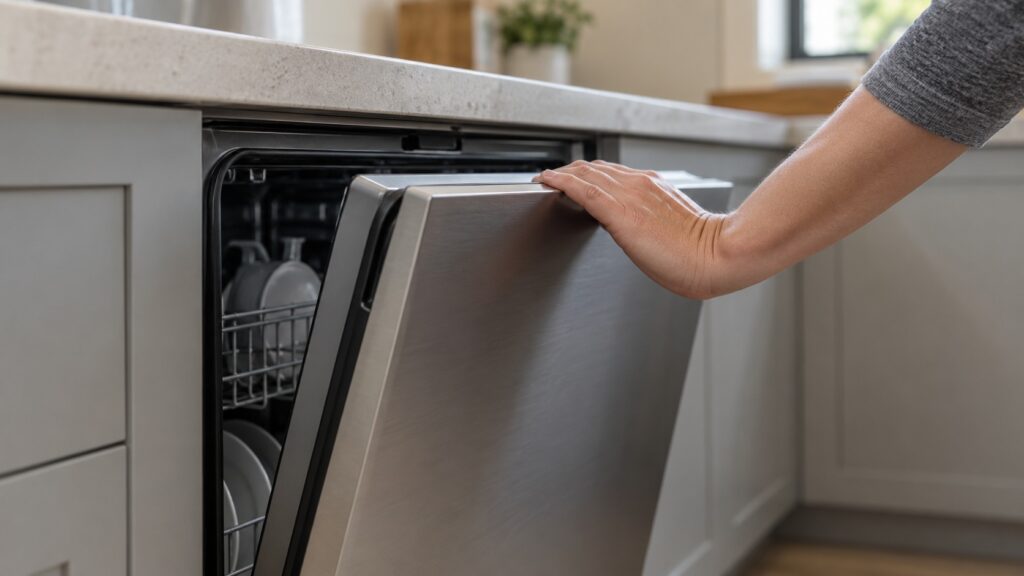
Open the door, check that nothing sticks out of the racks or catches on the door edge, close it firmly and confirm that it latches without needing extra force. If the door has to be pushed hard or slammed to get any response, that tells you the latch, the door alignment or the switch is the problem. Our page for a GE dishwasher door latch not catching lists a worn or broken latch hook, a door out of alignment, an upper rack rail that bumps the door and a failed door switch. Close the door slowly and watch where it touches the frame, and press evenly across the whole door rather than one corner. If a latch hook is worn or the switch is failing, it is a technician’s job.
Step 2: Is the dishwasher getting power?
Check the breaker, and if the dishwasher is plugged into a GFCI outlet, press its reset button. If the display is dark, power is the likely problem, not the dishwasher. After you reset anything, wait a full minute after power-cycling the breaker before testing again. If the breaker trips again when you restore it, leave the dishwasher off and book a visit. If water is near the plug or the cord, switch off the breaker at the panel while standing on a dry floor, and never pull a plug from a wet outlet.
Step 3: Is a delay-start or the control lock getting in the way?
If the display is lit but the cycle never begins, look for a delay-start indicator. A lit delay-start indicator means the dishwasher is waiting, not broken. Cancel any delay-start setting and press Start again. Then check whether the control lock is on. Hold the control-lock button combination to unlock the panel, which our page for GE dishwasher buttons not responding says is often a specific button held for three seconds. The exact buttons differ between GE panels, so check your owner’s manual. Dry the panel and avoid pressing buttons with wet hands.
What if it starts but stops before the wash?
That is a different chain: the dishwasher is running, but it is waiting for something. If it does not fill with water, our page on a GE dishwasher not filling with water lists the likely causes: a household shutoff valve that is not fully open, often bumped closed during plumbing work; a float switch stuck down; a kinked or clogged supply line; a clogged inlet valve screen; and a failed inlet valve. You can confirm the shutoff valve under the sink is fully open and check that the float in the bottom of the tub moves freely. Do not take the dishwasher apart; the inlet valve and the supply connections are technician work.
If it runs and then stops with a code, read the code. C2, C4, C5 and C8 are timing alerts rather than part numbers, and our GE dishwasher C2, C4, C5 and C8 codes guide explains each. If the water does not leave, read about a GE dishwasher not draining. PF is a power-failure flag, which only reports that the dishwasher lost power mid-cycle.
When is it the control board or the door switch?
When the door latches securely and power is confirmed but the dishwasher still will not start. Our page says an experienced technician should then test the door switch and the control board directly, and it rates the condition medium severity, so there is no emergency. A control board failure is less common than the earlier causes, and it is only worth considering after you have ruled them out. Ask the technician to test before replacing, because the parts involved are the door latch or switch, the control board and the power supply. An older dishwasher with a failed board is worth comparing against replacement. Have the model and serial number ready, and read about GE dishwasher repair before you book a visit.