GE error codes do not follow one scheme. A dishwasher speaks in C-numbers, a washer in E-numbers, an oven in F-numbers, and a refrigerator in two-letter words that look like abbreviations because they are. Looking up a bare code without knowing which appliance produced it is therefore not just unhelpful — it can land you on a page describing a completely different fault.
Why the schemes differ at all
GE builds across several lines and several factories, and the control platforms differ between them. A code scheme belongs to the control board family rather than to the brand, so appliances that share a platform share a scheme and appliances that do not, do not. That is the whole explanation, and it is worth knowing because it means the pattern will not become consistent over time.
It also means a code on one appliance says nothing about the same characters on another. E3 on a dryer and an E-code on a washer are unrelated, and a refrigerator’s FF has nothing to do with an oven F-code. Our oven F-code guide and the refrigerator FF page cover two of these worlds separately for exactly that reason.
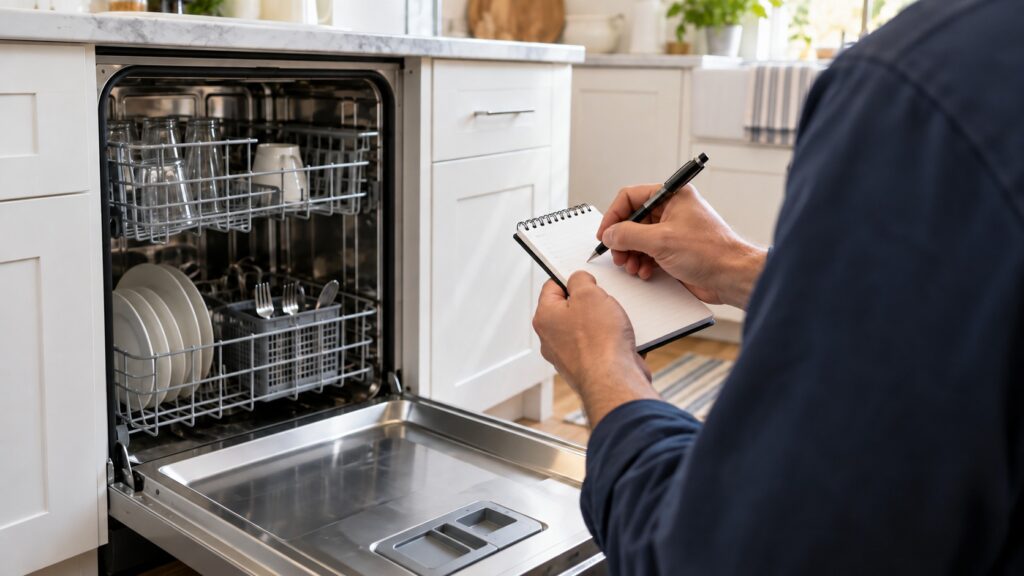
Write down the whole thing, not the number
Three details matter and people routinely discard two of them. The appliance, obviously. The full code including any letter and any suffix. And what the machine was doing at the time — filling, draining, heating, mid-cycle, or sitting idle.
That third item is the one that turns a code into a diagnosis. A dishwasher code raised while filling and the same code raised while draining point at opposite ends of the same circuit, and no lookup table can tell you which you had. Our model and serial number guide covers the other identifiers a technician will ask for.
The codes worth knowing by heart
- Dishwasher C1 and C3 — fill and drain conditions. Both usually resolve to a filter, a hose or a valve rather than a board. See C1 and C3.
- Oven F2 — the classic over-temperature report, and one that frequently follows a self-clean cycle. See our F2 page.
- Refrigerator dE — a defrost-related report, which matters because defrost failures build gradually. See the dE page.
- Washer E22 and E23 — drainage. Almost always a pump, a filter or a hose. See E22.
What every code has in common
Whatever the scheme, a code reports a condition the appliance detected, never a part that has failed. A drain code does not mean the pump is broken; it means water did not leave within the time allowed. A sock, a blocked filter, a kinked hose and a dead pump all produce the same characters.
That is why the useful first move is always the same: cut the power for two minutes. Many codes are latched and clear on restart. One that returns immediately is reporting a live condition and deserves the checking; one that does not return was history.
Where the code is displayed, and models with no display
Not every GE appliance has somewhere to print a code. On machines without a display, the same information comes out as a pattern of blinking lights — a program indicator flashing a set number of times, pausing, and repeating. That is a code, and it is looked up the same way once you have counted correctly.
Count the flashes twice before trusting the number, and note the pause: some appliances use two groups separated by a longer gap, which is two digits rather than one long count. A fully integrated dishwasher hides its display inside the door, so nothing is visible until the door is opened — which means an integrated machine is not a machine without codes, it is one whose codes you have to go looking for.
Retrieving a stored code
Several GE platforms keep a history of faults that is not shown during normal use, and reaching it needs a service or diagnostic mode — usually a button sequence held for a few seconds. That history is far more useful than the code currently on screen, because it shows whether a fault has happened once or twenty times.
Our guides on the refrigerator diagnostic mode and the dishwasher diagnostic mode cover how to enter them. 🔴 Entering a diagnostic mode is safe; running the test cycles it offers is not always — some drive components directly and will fill or heat regardless of what else is happening.
Codes that are not faults
Some are informational and get treated as emergencies. A refrigerator showing a code during a deliberate demo or showroom mode is describing a setting. An oven reporting a locked door during or after a self-clean cycle is describing a safety interlock doing its job — see our page on a door that will not unlock. And a code that appeared once, months ago, and has been sitting on a display since is not telling you about today.
When a code means stop rather than investigate
Three categories are not for working through. Anything accompanied by water on the floor, anything involving a burning smell or visible arcing, and any code on a microwave — that appliance holds a lethal charge in its capacitor long after unplugging and is not a place to explore.
Beyond those, the dividing line is whether the check is reachable without opening the cabinet. Filters, hoses, seals and vents are fair game. Boards, elements, valves and anything behind a panel are service work.
Getting help with one
We are an independent repair company, not a factory service arm. Pricing starts from a diagnostic visit and we confirm the estimate before any work begins. Our services cover every appliance in the range — dishwasher, washer, oven, refrigerator and the rest — and you can schedule a visit online with the code and the circumstances written down.