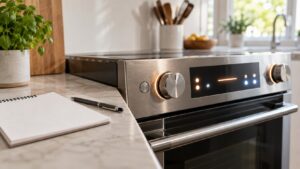
A ge oven temperature sensor test is one of the simplest ways to confirm whether uneven or inaccurate baking traces back to the sensor itself, rather than the bake element, the control board, or your own technique. The temperature sensor is a slim metal probe, usually mounted on the back or side wall of the oven cavity, that reports resistance values the control board converts into a temperature reading used to cycle the heating elements.
Why this test matters
Unlike the F3/F4 error codes covered on some GE oven models, which usually indicate the control board has already detected a sensor reading that is out of range, many temperature accuracy complaints never trigger a code at all – the oven simply runs consistently too hot or too cold without ever throwing a problem. In those cases, testing the sensor directly is the only reliable way to confirm it as the cause. See our related guide on GE oven F3/F4 code for the version of this problem that does trigger a problem.
How to test the sensor
- Unplug the oven or shut off power at the breaker for safety
- Locate the temperature sensor probe inside the cavity and access its wiring, typically at the back of the oven behind a small cover
- Disconnect the sensor’s wiring harness and set a multimeter to measure resistance (ohms)
- Measure resistance across the sensor’s two terminals at room temperature
- Compare the reading against the expected value for your specific model, typically in the range of roughly 1,080 to 1,110 ohms at 75°F on many GE ovens, though the exact spec varies by model and should be confirmed in your service documentation
Interpreting the results
A resistance reading dramatically outside the expected range – open circuit (infinite resistance) or a short (near zero) – confirms the sensor itself has failed and needs replacement. A reading within the expected range at room temperature does not fully rule out the sensor, since some sensors drift only at higher temperatures, but it does shift suspicion toward the control board or a wiring connection issue instead.
Symptoms that suggest a sensor test is worth doing
- Consistently over- or under-baked food despite correct oven settings and an accurate oven thermometer check
- An oven that seems to preheat unusually fast or unusually slow compared to its rated preheat time
- Uneven baking results that changed noticeably after a specific date, rather than a gradual drift
When to call a technician
Our oven repair technicians test the sensor against the correct specification for your exact model and can also rule out a wiring or control board issue in the same visit, rather than replacing the sensor on a guess and finding the problem persists.
Reading a live resistance value while the ge oven temperature sensor test is running
Beyond the single room-temperature check, some technicians run an extended ge oven temperature sensor test by leaving the sensor connected to the multimeter (using back-probe leads) while the oven heats up, watching resistance rise smoothly and predictably as temperature climbs. A sensor that jumps erratically, stalls at a fixed value despite rising heat, or drops instead of rising is failing intermittently under heat even though it passed the cold resistance check – this catches sensors that only misbehave once they are actually hot, which a single room-temperature reading alone can miss entirely.
Confirming with an independent oven thermometer
Pairing this ge oven temperature sensor test with a separate, independent oven thermometer placed on the center rack is the most reliable way to confirm a real-world temperature problem before condemning the sensor. Set the oven to a common baking temperature, let it fully preheat and stabilize, and compare the thermometer’s reading against the display – a consistent gap of 25 degrees or more in either direction, paired with a normal sensor resistance reading, shifts suspicion toward the control board’s calibration rather than the sensor itself.
Quick summary
A resistance test at room temperature is a quick, low-cost way to confirm or rule out a failed oven temperature sensor before assuming a more expensive control board replacement is needed.
Our experienced, independent technicians – not affiliated with GE Appliances, a Haier company, or General Electric Company – test temperature sensors against correct model specifications. Schedule service at /schedule/. General GE product information is at geappliances.com.