A GE microwave turntable that has stopped rotating is one of the few appliance faults where the cheapest cause is also the most common, and where a five-minute check settles it. The oven still heats, the light still comes on, and only the plate sits still — which makes it easy to ignore and easy to fix.
How the turntable is actually driven
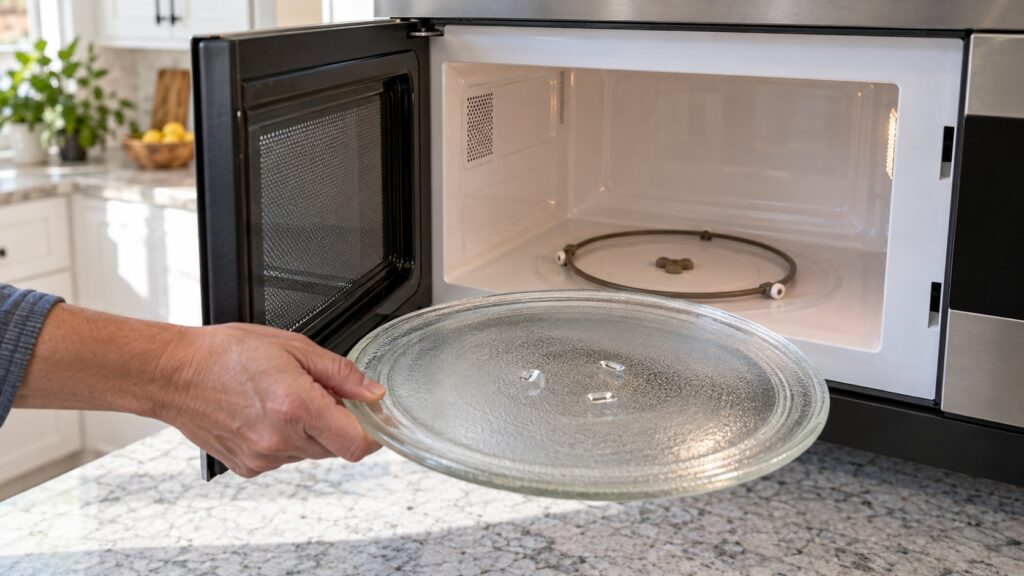
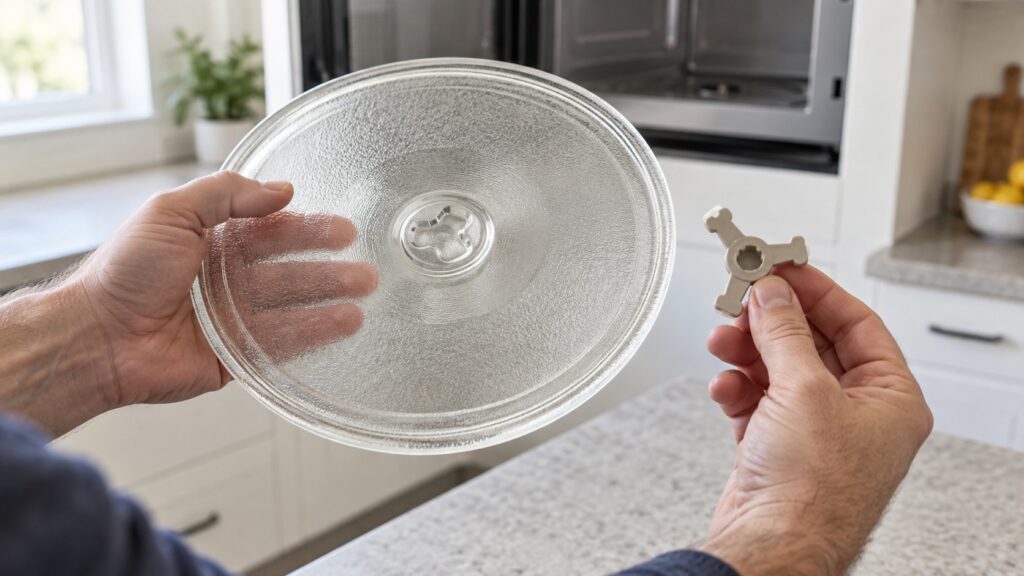
There are only four parts. A small motor under the floor of the cavity turns a shaft. That shaft ends in a coupler — a plastic hub with three raised arms. The glass plate sits on that coupler, and its weight is carried by a roller ring that runs in a track pressed into the cavity floor. Nothing else is involved.
Because the plate rests on the ring and is driven by the coupler, the two most common failures both leave the motor working perfectly. The plate can sit slightly off the coupler so the arms no longer engage, or the ring can hop out of its track so the plate binds. Both look identical from the front and neither needs a technician.
The five-minute check
- Take the plate out and wash the cavity floor. Food debris in the track is the single most common cause, and it is invisible with the plate in place.
- Look at the roller ring. Every wheel should be present and should spin freely between finger and thumb. A missing or seized wheel makes the plate drag.
- Look at the coupler. Its three arms should be square and unworn. Rounded arms no longer grip the plate.
- Refit deliberately. The plate has a recess on its underside that must drop onto the coupler arms. Turn it by hand until it seats and drops slightly.
- Run it empty for thirty seconds with a cup of water inside and watch from the front.
If the plate now turns, you are done. If the coupler itself turns while the plate does not, the plate is not seated or the coupler arms are worn — both are parts you can replace without opening anything.
When the coupler turns and the plate does not
This is the clearest diagnosis available. Take the plate out and start the oven for a few seconds with a cup of water inside. If the coupler spins, the motor and the drive are fine and the fault is above them — a worn coupler, a cracked recess in the plate, or a plate from a different model that never fitted properly.
Replacement plates and couplers are inexpensive, and they are model-specific: the arm spacing and the plate diameter differ between GE microwaves that look similar. Our guide to finding the model and serial number is the first step in ordering the right one.
When nothing under the plate moves
If the coupler does not turn either, the drive motor or its supply has failed. That is a genuine repair, and it is the point at which this stops being a five-minute job — the motor sits beneath the cavity floor, and reaching it means opening the cabinet.
🔴 That is not a DIY job on any microwave. The high-voltage capacitor stores a charge capable of killing someone long after the appliance is unplugged, and it does not announce itself. This is the one appliance in the kitchen where we would rather you called somebody than opened it.
Over-the-range models add one more cause
A microwave mounted above a range lives in a stream of steam and grease rising from the cooktop below, and that changes what accumulates under the plate. Instead of dry crumbs you get a sticky film that builds on the roller wheels and in the track, and it does not shake out — it has to be washed off.
Two consequences follow. An over-the-range unit needs the plate and ring taken out more often than a countertop one, and a turntable that has become reluctant rather than stopped is usually telling you about that film rather than about a part. Our grease filter guide covers the extraction side, which is what determines how much reaches the microwave in the first place.
Things that look like a turntable fault
- A dish too large for the cavity catches on the wall and stops the plate. Obvious once seen, invisible through a closed door.
- A plate loaded off-center with something heavy can stall the motor without anything being broken.
- A turntable switched off deliberately — some models have a setting for this, usually for oversized dishes.
- Uneven heating blamed on the turntable is often a magnetron issue instead — see our page on a microwave that will not heat.
Keeping it working
The whole maintenance routine is one habit: take the plate and the ring out when you clean the microwave rather than wiping around them. Debris migrates under the plate and into the track, and the track is the part you never see. Wash both in warm soapy water, dry them, and refit the ring before the plate.
Our microwave maintenance guide covers the rest, and the turntable parts guide covers what each component is called when ordering.
When to call
A coupler that does not turn, a motor that hums without moving, a burning smell, sparking inside the cavity, or a door that no longer latches squarely — those are service work, and the last three are urgent.
We are an independent repair company, not a factory service arm. Pricing starts from a diagnostic visit and we confirm the estimate before any work begins. GE microwave repair covers the drive, the magnetron and the door interlocks, and you can schedule a visit online.