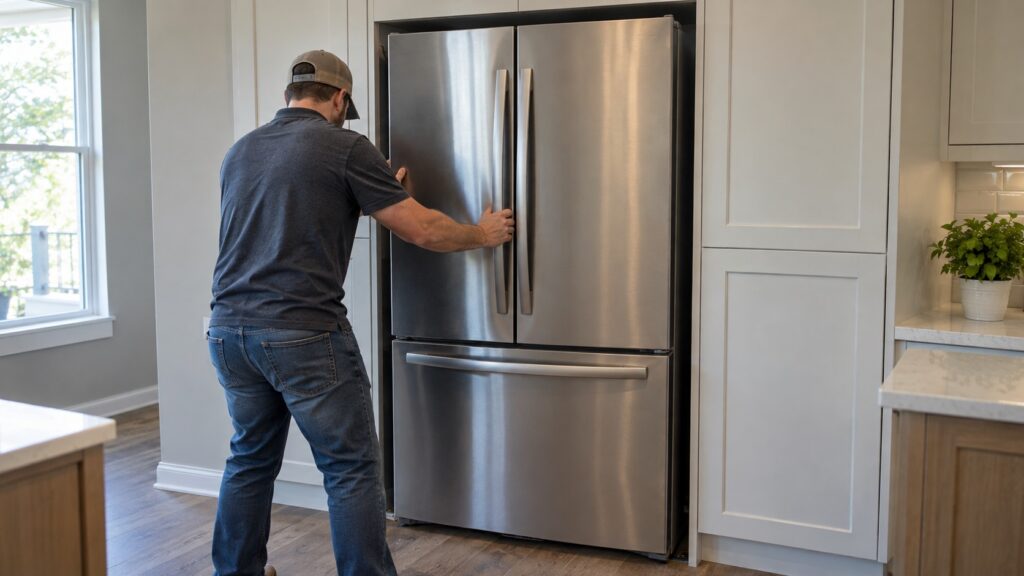
A correct GE refrigerator installation comes down to three things most kitchens get wrong at least one of: clearance for airflow around the compressor and condenser, a dedicated water line for the ice maker and dispenser, and door leveling on French Door and side-by-side models where two doors have to meet flush. Get any of the three wrong and the refrigerator will still turn on — it just will not cool evenly, make ice reliably, or close cleanly.
How much clearance does a GE refrigerator need around it?
The compressor and condenser coil reject heat into the surrounding air, and a refrigerator boxed in tight on all sides has nowhere for that heat to go. Most GE models call for roughly an inch of clearance on each side and at the top, though built-in and cabinet-depth models have their own spec sheet numbers that can differ — check the installation instructions for your exact model rather than assuming a standard freestanding fridge’s clearances apply. A unit installed flush against cabinetry on both sides commonly runs warmer than it should and cycles the compressor more often, which shows up later as a service call for “not cooling” that is really an airflow problem from day one.
Does a GE refrigerator need a dedicated water line?
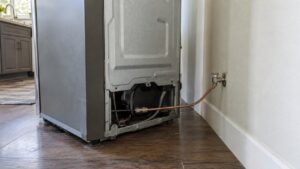
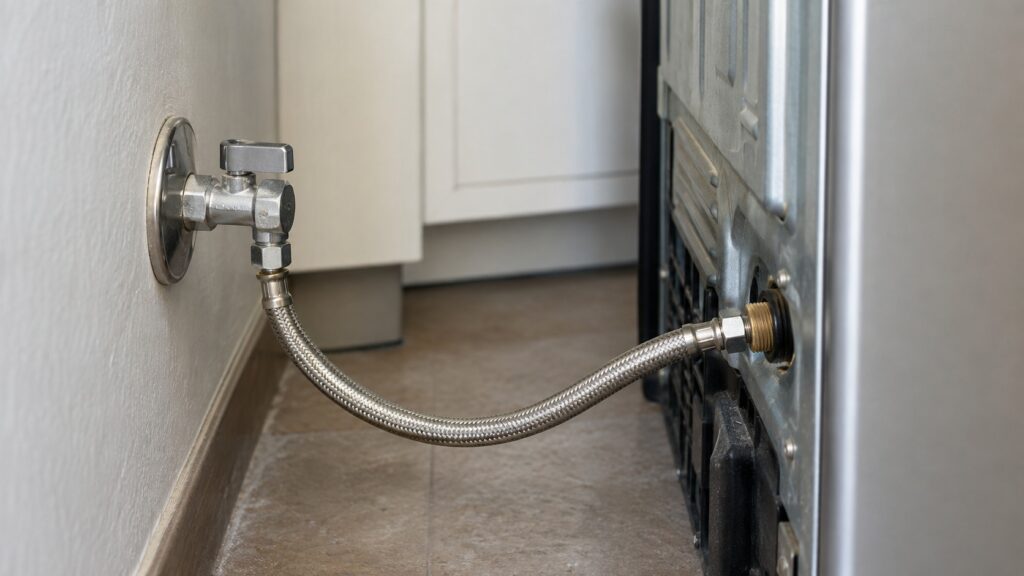
Any model with an ice maker or a dispenser needs its own 1/4-inch line running to a shutoff valve — not a saddle valve pierced into an existing supply pipe, which restricts flow and is the single most common cause of slow ice production and dispenser trouble on a newly installed unit. A proper installation taps into the cold water line ahead of any other fixture, runs a dedicated shutoff at an accessible point, and leaves enough slack in the line behind the refrigerator that the unit can be pulled out for service without disconnecting the water.
How do you level a GE French Door or side-by-side refrigerator?
Front feet set slightly higher than the rear feet let gravity pull the doors closed on their own rather than letting them drift open. On French Door models, leveling also decides whether the two doors meet flush in the middle — a refrigerator that is not level side-to-side will show a visible gap or overlap where the doors meet, even when each door closes fine on its own. Adjust the front leveling legs first, check the doors meet evenly, then fine-tune rather than trying to fix door alignment by shimming the floor.
What floor and doorway clearances matter before delivery day?
A full-size French Door model loaded with food routinely exceeds 400 pounds, which matters most on upper floors or over unsupported spans — check with a contractor if there is any doubt, rather than after the unit is in place. Measure the doorway width and any hallway turns against the refrigerator’s shipping dimensions, not just its installed width, since the door panels and handles often need to be removed to get a large French Door unit through a standard doorway. Measure twice before delivery; a refrigerator that does not fit through the door it needs to pass is a returns problem, not an installation one.
Do built-in and counter-depth GE refrigerators need different clearances?
Yes — a built-in model is designed to vent through the front grille rather than the sides and top, so its cabinet opening and clearance numbers come from the spec sheet for that exact model rather than the general rule of an inch on each side. A counter-depth freestanding model still vents from the sides and back like a standard freestanding unit, even though its shallower cabinet makes it look built-in once it is installed. Mixing up the two categories is an easy mistake during a kitchen remodel, since a counter-depth refrigerator installed into a built-in-style opening with no side clearance will run into the same overheating problem a full-depth model would.
Does an existing kitchen outlet or water line ever need upgrading before delivery?
Sometimes, and it is worth confirming before delivery day rather than discovering it with the truck outside. A kitchen built or last remodeled decades ago may have only a shared outlet near the refrigerator space rather than a dedicated circuit, and running a new circuit is an electrician’s job that should happen ahead of time, not improvised on delivery day. The same goes for homes that have never had an ice-making refrigerator in that spot — if there is no water line stubbed out anywhere near the installation point, running one is a plumbing job worth scheduling before the new refrigerator arrives, since a delivery crew installs the appliance, not the infrastructure behind it.
What should you check the first day after installation?
Give the refrigerator 24 hours to reach temperature before loading it with a full week of groceries — the compressor needs that time to pull the cavity down from room temperature, and loading it heavily on day one slows that process further. Confirm the water line is not weeping at any fitting, and expect the first few batches of ice to taste faintly like the plastic supply line; that clears after a few cycles and is not a fault.
Check the outlet behind the unit too: a GE refrigerator needs its own grounded, properly rated circuit rather than a shared outlet running an extension cord or a power strip, since a refrigerator plugged into a circuit that also runs other appliances can trip on demand spikes that have nothing to do with the refrigerator itself. Walk around the installed unit and confirm the side and top clearances are actually what the spec sheet calls for, not just what looked close enough when the delivery crew set it in place. It is far easier to slide a refrigerator an inch away from a cabinet on day one than to diagnose a mysteriously warm freezer six months later and trace it back to a gap that was never there. The same goes for the water line: a kinked or crimped section behind the unit can look fine on delivery day and only start restricting flow once the line settles into its final position.
If cooling still lags after that first day, or the ice maker never starts producing, the issue is worth checking against clearance and water supply before assuming a part failed. Our guide to GE refrigerator not cooling covers what to check next, and GE ice maker installation goes deeper on the water-line side specifically for the ice maker module. A visit starts from a standard diagnostic call with the estimate confirmed before any part is ordered — we are an independent repair company, not a factory service arm. GE refrigerator repair covers anything that turns up after install, and you can schedule a visit or call (844) 524-4561.