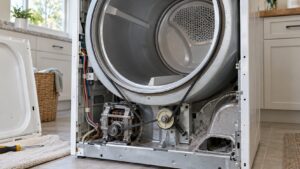
A ge dryer taking too long to dry – where a normal load now needs two or three cycles instead of one – is a complaint we hear constantly, and it is worth taking seriously even before it escalates into an outright error code, since it is almost always the earliest visible sign of restricted airflow through the dryer.
Vent restriction: the leading cause
As lint accumulates inside the exhaust duct over months of use, the dryer has to work progressively harder to push moist air out, which means cycles take longer and longer even though nothing has technically failed yet. Left unaddressed, this same restriction is what eventually triggers the GE dryer E3 code, so a dryer that has been getting steadily slower is often just a few months away from an outright exhaust problem.
Lint trap buildup
A lint trap that is not cleaned before every load restricts airflow right at the source, before air even reaches the exhaust duct. This is the single easiest thing to check and fix, and it takes seconds each time you start a new load.
Overloading the dryer
Packing the drum too full prevents clothes from tumbling freely through the airflow path, which slows drying regardless of how clear the vent itself is. As a rule of thumb, the drum should be no more than about three-quarters full to dry efficiently.
Duct length and layout
- A duct run longer than the manufacturer’s recommended maximum length restricts airflow even when perfectly clean
- Excessive elbows or bends in the duct route add resistance beyond straight-line length alone
- Crushed flexible ducting behind the dryer restricts flow at a single point, sometimes severely
Sensor and heating issues
Less commonly, a drifting moisture sensor or a thermistor reading incorrectly can cause the dryer to run longer cycles than actually needed because it never registers the load as dry. See our GE dryer E1 code guide if a thermistor failure is showing on the display alongside the slow drying.
First checks you can do
- Clean the lint trap before every single load, without exception
- Reduce load size to roughly three-quarters of drum capacity and see if dry time improves
- Disconnect and inspect the exhaust duct for visible lint buildup or kinks
- Check the exterior vent cap for blockage or a stuck damper
When to call a technician
If the vent and lint trap are clean and load size is reasonable but drying still takes noticeably longer than it used to, our dryer repair technicians can test the moisture sensor and thermistor directly to rule those out, and can also professionally clean a duct run that is too long or too clogged for a homeowner to fully clear.
Why this is worth fixing before it becomes E3
Because vent restriction severe enough to slow drying noticeably is the same restriction that eventually overheats the exhaust path, addressing a ge dryer taking too long to dry complaint early is both a convenience fix and a fire-safety precaution, not just a comfort issue.
Quick summary
Slow drying is almost always an early vent-restriction symptom rather than a mysterious new problem, and a thorough duct cleaning resolves the majority of reports before they ever escalate to an E3 shutdown.
Tracking cycle times as an early warning
Keeping a rough mental note of how long a normal load usually takes turns a ge dryer taking too long to dry complaint into an early-warning system rather than a surprise, since a gradual creep from one cycle to two – the classic sign of a ge dryer taking too long to dry – is far easier to catch and fix with a simple duct cleaning than waiting until the dryer stops heating altogether.
Our experienced, independent technicians can inspect and clean the full exhaust path and test related sensors using OEM or high-quality replacement parts where needed. Schedule service at /schedule/. For general product information, visit geappliances.com.