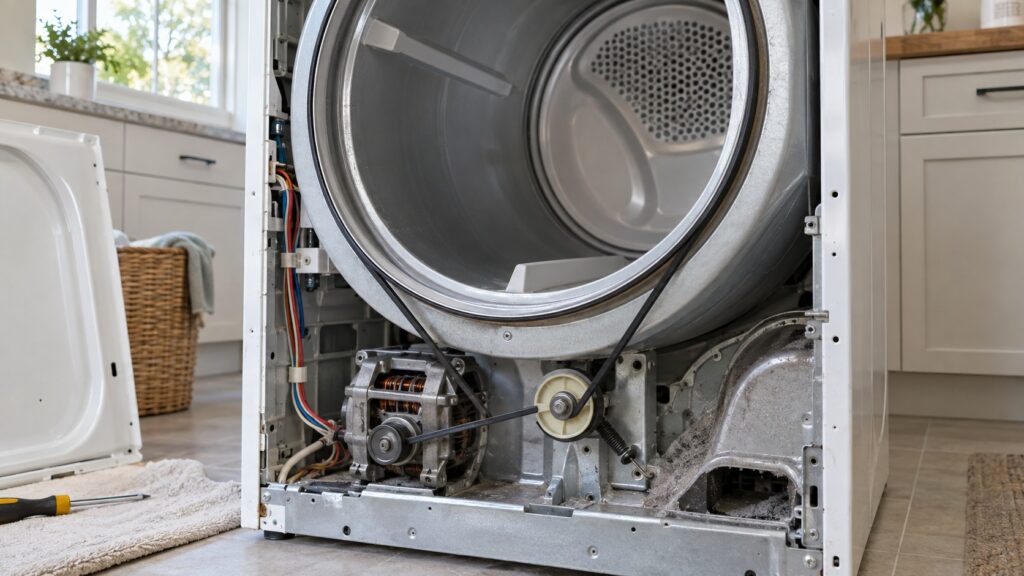
Almost every noise a dryer makes comes from four parts that carry or turn the drum: the belt, the idler pulley, the drum rollers and the rear bearing. GE dryer drum rollers and the belt that drives them are consumables — they wear on a schedule measured in loads, not in faults — and knowing which noise belongs to which part turns an alarming symptom into a routine repair.
Reading the noise
Each part has a characteristic sound, and identifying it before opening anything saves ordering the wrong component.
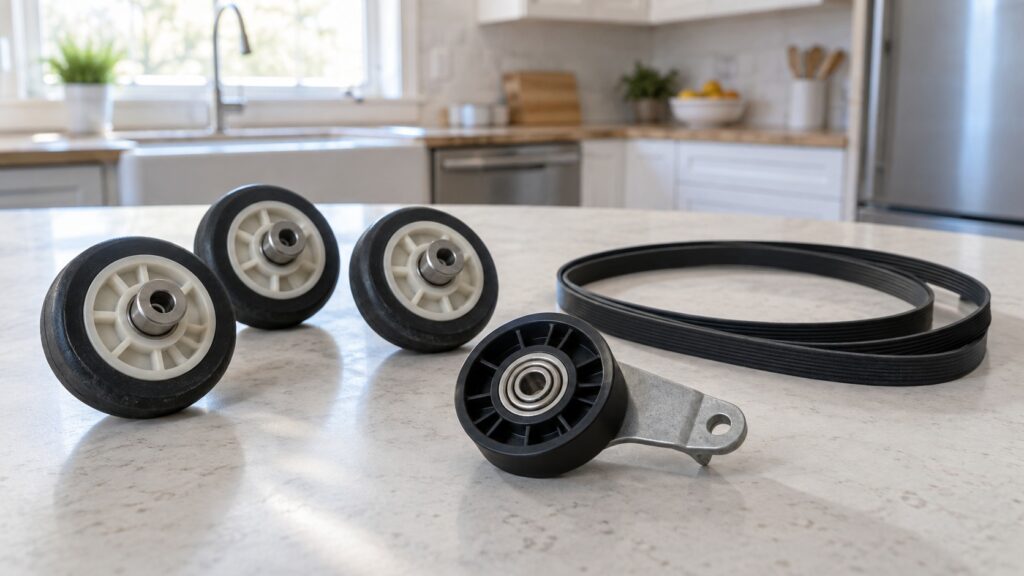
A rhythmic thump that keeps time with the drum is a flat spot on a roller. Rollers are usually replaced as a set, because one that has flattened means the others are the same age and close behind. A continuous squeal that changes with drum speed is the idler pulley — its bearing has dried out and it is the cheapest part in this group. A deep rumble that has grown over months is rollers generally. And a grinding that is worse with a full drum points at the rear bearing, which carries the load.
The drum that will not turn at all
If the motor runs and the drum sits still, the belt has snapped. That is the classic sequence and it is unmistakable: the machine sounds normal, the timer counts down, and nothing rotates. Reach in and turn the drum by hand — if it spins freely with no resistance at all, there is no belt on it.
A snapped belt is not a machine at the end of its life. It is a consumable, and the reason it snapped is usually age plus a worn idler pulley that has been fighting it. Replacing the belt without replacing the pulley is why some people replace two belts in a year.
Replace as a set, not one at a time
- Belt and idler pulley together. The pulley is inexpensive and it is what killed the belt.
- Rollers as a set. Same age, same wear. Replacing one shifts the load onto the next one to fail.
- Felt seals while you are in there. Worn drum seals let air bypass the drum, which lengthens every cycle afterward.
- Check the blower wheel at the same time — a cracked one makes its own noise and is right there.
Why they wear, and what shortens it
Rollers and belts wear from rotation, so a household drying several loads a day reaches this point sooner than one drying twice a week. Beyond that, two things shorten their life. Overloading puts more weight on the rollers and more tension on the belt every rotation. And a restricted vent makes every cycle longer, which is simply more rotations for the same laundry.
That second one is worth dwelling on: a blocked vent does not only waste energy, it wears the mechanical parts faster. Our vent cleaning guide is therefore a mechanical maintenance job as much as an efficiency one, and our page on long cycles covers the diagnosis.
What is not a roller or a belt
A dryer that turns but does not heat is a different group of parts entirely — the element or burner, the thermal fuse and the thermistor. Our thermal fuse and thermistor guide covers those, and the no-heat page covers the diagnosis.
A rhythmic thump that appeared suddenly is usually something in a pocket or a shoe in the load rather than a roller. Empty the drum and run it briefly before assuming a part, because the two sound remarkably similar.
Where the line is on doing it yourself
These repairs are mechanical rather than electrical, and on many dryers the front panel comes off with a few screws. But the drum has to come out to reach the rollers and the rear bearing, and getting a belt back around the motor pulley by feel is genuinely awkward the first time.
🔴 Whatever you attempt, unplug the machine first, and on a gas dryer shut the gas off at the valve as well. A dryer is not a microwave — there is no stored charge — but it is a heavy cabinet with sharp edges and, on gas models, a live supply line.
How long these parts last
There is no calendar answer, because wear tracks rotations rather than years. A household drying two loads a day reaches a set of rollers in perhaps seven or eight years; one drying twice a week may never replace them. What is consistent is the order: the idler pulley usually complains first, rollers next, the belt fails somewhere in the middle, and the rear bearing last if at all.
That order is useful because it means a squeal is an early warning rather than an emergency. A pulley caught at the squealing stage is a small part and an hour of work; the same pulley ignored for six months takes the belt with it and, occasionally, lets the drum drop far enough to scrape.
Stacked and closet installations
Where the dryer is stacked over a washer or built into a closet, the same repairs need the machine brought out and, on a stacked pair, unstacked. That is not difficult but it is a two-person job, and it is worth knowing before a technician arrives — a closet with a doorway narrower than the appliance turns a routine visit into a longer one.
It is also an argument for dealing with a noise early. An appliance that has to be dismantled out of a closet is a job you want to do once, with every worn part in the same visit, rather than twice.
When to call
A grinding that has become loud, a drum that has dropped and is scraping the cabinet, a burning smell, or noise that has appeared alongside longer cycles — those want attention promptly. A drum scraping its housing damages the drum, which turns an inexpensive repair into an expensive one.
We are an independent repair company, not a factory service arm. Pricing starts from a diagnostic visit and we confirm the estimate before any work begins. GE dryer repair covers drives, bearings, heating and controls, and you can schedule a visit online.