A GE microwave humidity sensor fault shows up as F4 when the sensor circuit is open and F5 when it has shorted, and F6 means the temperature probe circuit has shorted. All three are sensor faults, not heating faults: the microwave usually still cooks on a plain timer, but sensor-cook, auto-cook and probe-guided programs will stop or behave oddly. Those definitions come straight from the GE microwave pages on this site, and they hold across the over-the-range and countertop models that carry sensor cooking.
What does a GE microwave F4 code mean?
F4 is the open-circuit code for the humidity sensor. The sensor is used mainly for the sensor-cook and auto-cook programs, which judge doneness by the steam coming off the food rather than by a set time. When the circuit is open, because the sensor has failed inside or a connector has come loose, the microwave cannot read steam and refuses the program. The signs are F4 on the display, sensor programs that will not start or finish properly, and manual timed cooking that still works normally. Models on our site that carry this sensor include the Profile PVM9005SJSS and PVM9179SRSS and the Café CEB1599SJSS and CVM2072SMSS.
How is F5 different from F4?
F5 is the counterpart on the same humidity sensor: where F4 is an open circuit, F5 is a short. The result is similar, with sensor programs behaving inconsistently while timed cooking still works, but the causes differ. A shorted sensor can be the sensor failing internally or a pinched or corroded wire shorting the circuit. Both are low-severity faults, because nothing is overheating and the microwave is safe for plain use. Our F4 page and F5 page give the full reference for each.
What does F6 mean?
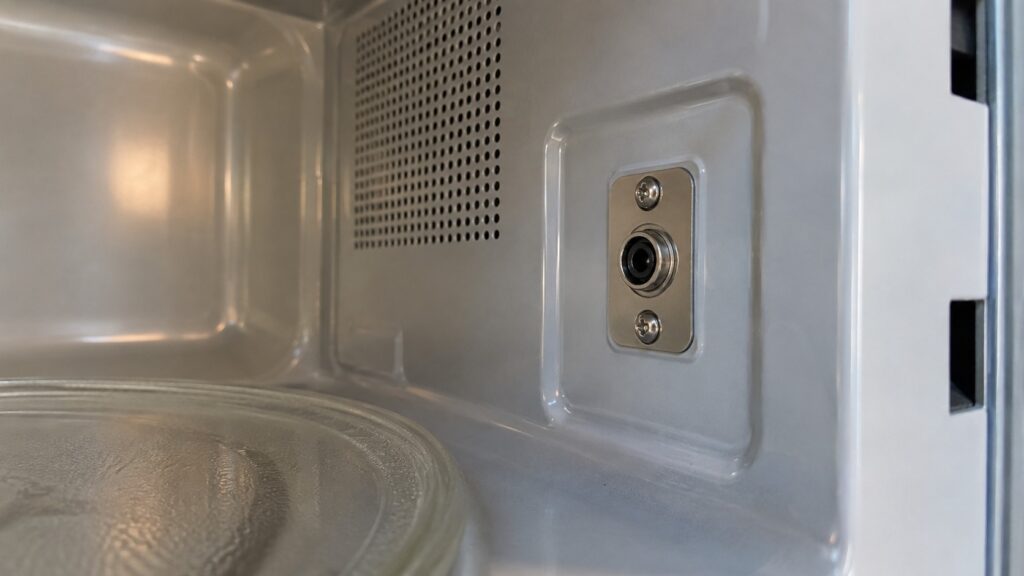
F6 is the shorted temperature probe code. It affects only probe-guided cooking, in which a metal probe plugged into a socket in the cavity reads the food temperature. The code appears when the probe is plugged in, and probe cooking will not proceed, while regular cooking without the probe still works. The cause is either the probe or its cable, with internal damage to the wire, or the probe receptacle inside the cavity. The Café CVM2072SMSS lists a temperature probe among its features, and it is the kind of model where this code appears.
What can I try safely?
These checks are quick and need no tools. Run a plain timed cook, for instance one minute on high with a cup of water, to confirm the microwave still heats; if it does, you have a sensor fault and not a heating fault. Unplug the microwave for a minute to power-cycle the control, then try a sensor program again. For F6, unplug the probe and check that the code does not return without it; if it does, the receptacle is the suspect. Inspect the probe cable for visible damage or kinks, and do not use a probe that looks damaged. Keep the cavity and the vent area clean, because grease and steam residue near the humidity sensor can make a marginal sensor worse.
Do not open the cabinet. A microwave stores a high-voltage charge in its capacitor even when unplugged, and the sensor wiring sits near it. Anything beyond the steps above should go to a technician.
What does a technician replace?
For F4 and F5, a technician tests and replaces the humidity sensor and checks the sensor wiring harness; for F6, the probe, the receptacle and the probe wiring. The part is matched to your model and serial number. In most cases the repair is small relative to the microwave, though on an older model with other faults you may prefer to weigh options. Related faults are covered elsewhere on this site: F1 and F2 thermal sensor codes, the F3 shorted touchpad code and a microwave that does not heat. For repairs, GE microwave repair covers these models, and you can book a visit.
Can I keep using the microwave with F4, F5 or F6?
Yes for plain cooking, with sense. The faults are low severity and do not make the microwave unsafe, because the sensor circuits are not part of the high-voltage side. What you lose is sensor cooking or probe cooking. The sensible approach is to use timed power levels and check food by hand until the sensor is replaced, and to avoid relying on auto programs that the code says cannot read doneness. If the code is joined by sparking, a burning smell, or the unit tripping the breaker, stop using it and call. If the microwave simply shows 888 or PF after a power cut, that is a clock reset, not a fault, and you only need to set the time.
How does sensor cooking work, and why does it need these parts?
Sensor cooking is a way of letting the microwave decide the cook time. As food heats, it gives off steam, and a humidity sensor in the exhaust path reads how much. The control watches the reading rise, notes the point where steam peaks, and adds the remaining time based on the food type you chose. Because the control depends on that reading, it refuses to run the program if the sensor circuit is open or shorted. That is the logic behind F4 and F5: the microwave cannot run a program it cannot measure, so it stops instead of guessing.
Probe cooking is simpler. A metal probe in the food reports its temperature through the socket in the cavity wall, and the microwave stops when the target is reached. F6 simply says the probe circuit is shorted, so the control will not trust the reading. Because both systems are sensing circuits, they have nothing to do with the magnetron, the part that makes the microwaves. A microwave with F4, F5 or F6 and no heating problem is not losing power.