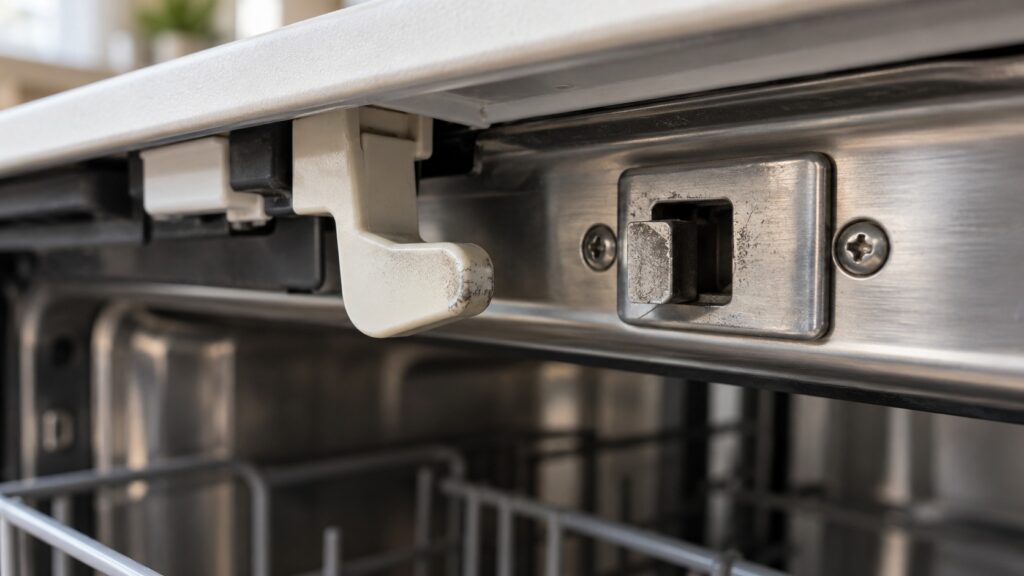
The GE dishwasher door latch is not one part but a small assembly: a latch hook that catches the door, a strike plate on the tub, and a door switch that tells the control the door is shut. A GE dishwasher will not start unless all three agree, so a worn hook, a shifted door or a failed switch all look the same from the front: the door swings shut, the cycle never begins, and the lights may still be on. This guide explains each part, how it fails, what you can safely check and how to tell a latch problem from a control problem, so you can decide whether it is a quick fix or a repair for a technician.
What does the GE dishwasher door latch actually do?
It does two jobs. Mechanically, it holds the door shut against the pressure of hot, sprayed water so the dishwasher does not leak. Electrically, it closes a switch that completes the circuit to the control. Without that signal, the control will not fill the tub or start the pump, and that is a safety feature, not a fault. A dishwasher that runs a wash with the door unlatched would spray water across the kitchen floor.
Most no-start complaints on GE dishwashers come back to the latch circuit. Our dishwasher will not start page lists door latching as the first cause, ahead of a tripped breaker, a delay-start setting or a control lock.
How does a latch hook or strike plate fail?
With wear, not with a bang. Every time the door shuts, the hook rubs the strike plate. Over years, the plastic hook wears round, the plate wears smooth, and the catch becomes loose or fails to engage on the first push. The signs, as our door latch not catching page describes, are a door that swings shut without a click, a door that needs a push or a slam, and a visible gap between the door and the tub frame. A hook can also crack at the neck or break off, in which case you may find a piece of plastic in the tub or the bottom rack.
A latch that sticks closed instead is a different problem. If the door will not open after a cycle, wait for the cycle to end, switch the dishwasher off at the breaker, and try again. A hook that has seized can need a technician to free it without breaking the door frame.
What does a door switch do, and why does it fail?
The door switch is a small electrical switch pressed or released by the latch. When it closes, the control knows the door is shut. Switches fail from heat, moisture and thousands of cycles, and the usual sign is a latch that catches properly while the dishwasher still behaves as if the door were open. The control may light up but not start, or start and stop, or respond only when you press hard on the door. Because the fault is electrical, it cannot be seen. A technician tests the switch with a meter and replaces it if it does not read closed.
What else can look like a latch failure?
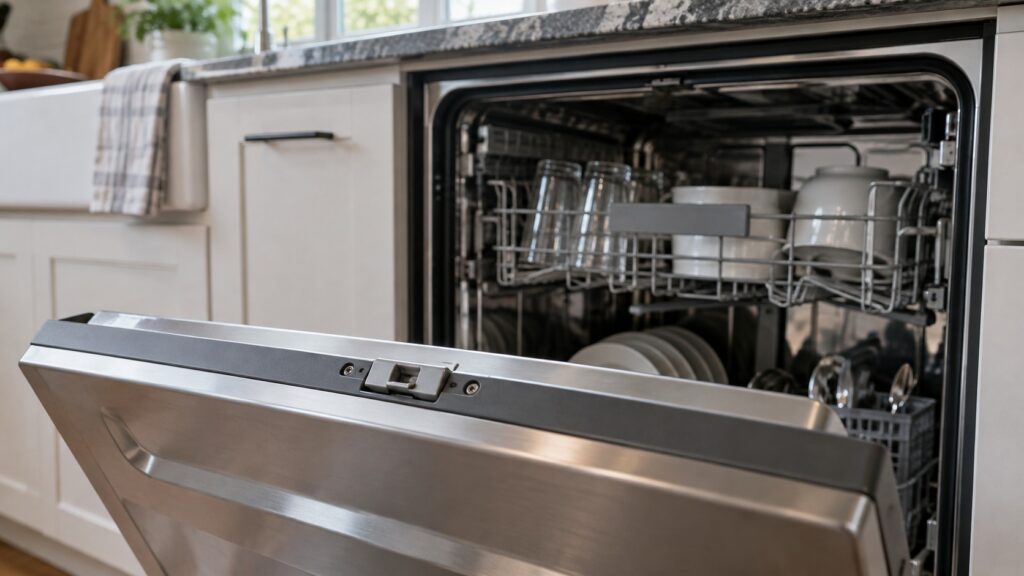
- A rack rail or clip that sticks out. An upper rack rail that extends far enough to catch the door edge stops it from seating. Push the rack fully in and look at the rails.
- Loading that blocks the door. A tall pan, a utensil handle or a spray arm that is jammed against the door will hold it open a fraction.
- A door out of alignment. Hinge wear can shift the door slightly, so the hook and strike no longer meet squarely. Look at where the door touches the frame as you close it slowly.
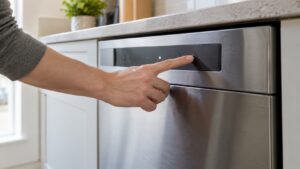
- A locked control panel. A control lock can make the dishwasher seem dead even with the door latched.
- A delay-start setting. The dishwasher may be waiting, not failing.
Rule these out first. If you have a lit display and the buttons ignore you, the cause may be the panel and not the latch; our buttons unresponsive page covers that.
What can you safely check yourself?
- Switch the dishwasher off at the breaker if you are going to look near the latch.
- Empty the upper rack and push it fully in, then check the rails and clips.
- Close the door slowly and watch where it first touches the frame.
- Look at the latch hook and the strike plate for cracks, chips and rounded edges.
- Press the door with firm, even pressure over its whole width. If the latch catches only with pressure on one corner, alignment is the likely cause.
- Restore power, wait a minute, and try a cycle.
Do not bend the door, force the latch, or take the inner panel off with the power on. The switch wiring sits right behind the panel, and the tub can hold water. If your dishwasher has a diagnostic mode, our GE dishwasher diagnostic mode guide can help show whether the control is receiving a door-closed signal.
What does a repair involve?
A technician finds out which of three things has failed: the hook and strike, the switch, or the door alignment. Replacing a worn latch assembly is a routine repair, and a failed switch is similar. Door alignment may need a hinge or spring adjustment. The correct part for your dishwasher is matched from the model and serial number, and a genuine OEM part is fitted only against a positive test. Before you buy any part, confirm the failed one, since changing the hook when the switch is bad only costs time. A part swap on a sound dishwasher is usually far cheaper than a new unit, which is worth remembering when you read our GE dishwasher buying guide.
If the latch is working but the dishwasher still reports trouble, look at the codes: our C2, C4, C5 and C8 guide explains the common ones. When it is time for a visit, GE dishwasher repair is the place to start, and we are an independent service, so we will say plainly whether it is a latch or something else. You can book a visit online.