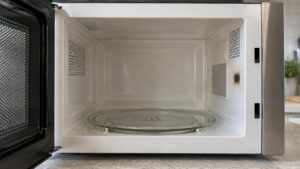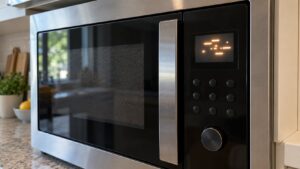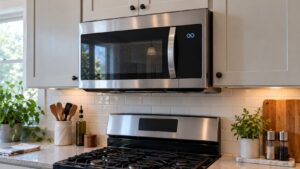
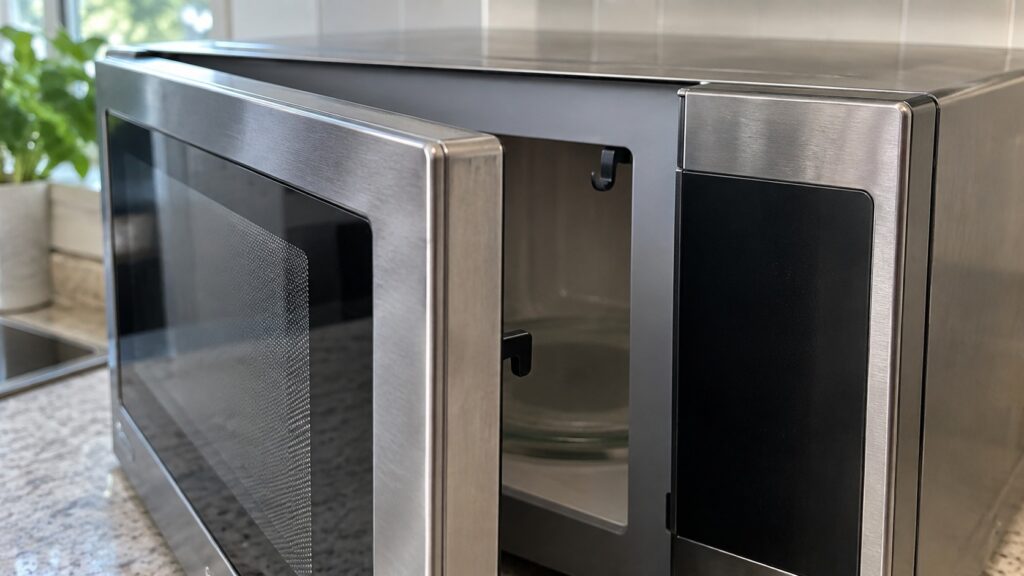
The GE microwave door latch is a small assembly of latch hooks and interlock switches that confirms the door is fully closed before the microwave is allowed to produce energy. When a hook wears or breaks, or a switch stops confirming a closed door, the microwave will not start even though the door looks shut. The latch hooks are the most common mechanical failure, a door that has drifted out of alignment on its hinges is the next, and a failed interlock switch is the electrical cause behind a door that latches but is never registered as closed.
What does the door latch do on a GE microwave?
A microwave must prove that the door is shut before it generates microwave energy. The latch hooks on the door catch the cabinet, and the interlock switches read the position of the door. Together they form a safety system, so a microwave with a faulty latch simply refuses to start. That behavior is correct: it is the system doing its job, not a defect in the control. Our page on the GE microwave door that will not close or latch describes the symptom, and this guide describes the parts behind it.
Because it is a safety system, the rules are strict. Never bypass an interlock switch, tape the door shut or run the microwave with a door that does not close squarely. A microwave that is used with a broken latch is a risk to the person standing next to it, and no repair trick is worth it.
How do latch hooks fail?
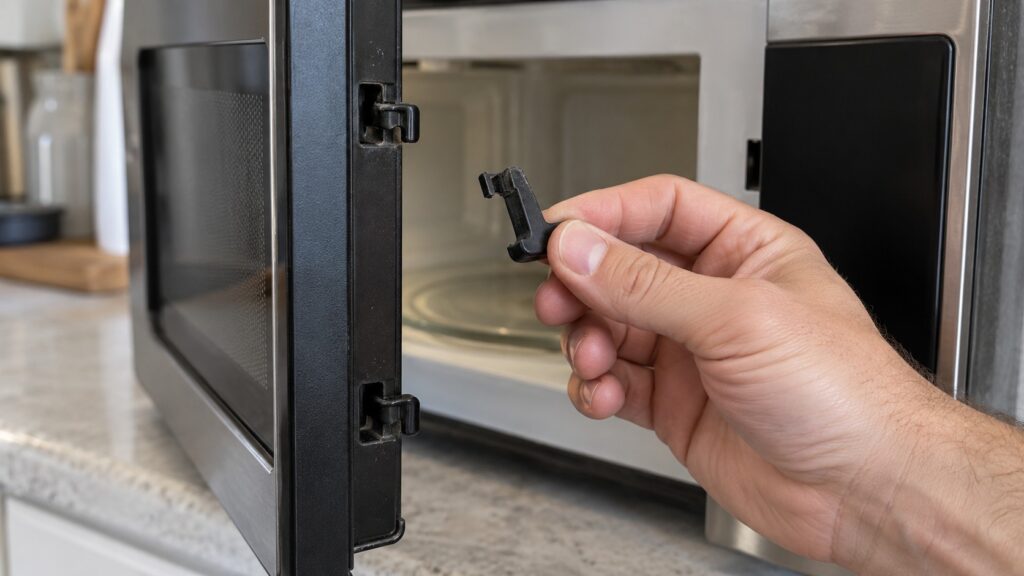
Latch hooks wear out from years of opening and closing. A hook that is worn or broken no longer engages fully, so the door does not click into a closed position, needs extra force or a particular angle to latch, or leaves a visible gap along one edge. Food residue in the latch path can have the same effect, because it prevents the hook from seating. Many owners find the first sign is a door that needs a push: if you ever have to lean on the door to make the microwave start, a hook is already at its limit.
The hooks are small parts that take a knock every time the door closes, so they wear. The part is matched to your model and serial number, so we cannot say which hook yours uses. Our guide to OEM and aftermarket GE parts explains how to choose the right replacement.
What do the interlock switches do, and how do they fail?
The interlock switches are the electrical half of the latch. When the door closes, the hooks move the switches, and the control reads them as closed. A switch can fail even though the hooks are perfect: the door latches mechanically, but the electrical switch does not confirm it. The symptom is a unit that will not start with the door visibly shut, and the cure is to test and, if needed, replace the interlock switches. This is a technician’s job. The switches sit inside the case, where the wiring carries household voltage and a high-voltage capacitor can hold a charge even when the unit is unplugged, so do not remove the cover to look.
What can you check safely at home?
You can do these four checks, all with the microwave unplugged:
- Clean the latch area and the hooks of any food residue, using a damp cloth.
- Close the door slowly and note exactly where it fails to seat.
- Look at the hooks for visible wear or breakage.
- Do not force the door shut. Forcing it can damage the latch or the hinge further.
Also check the door seal and the frame for food, and see whether the door sits crooked. If the hooks look intact but the unit still will not register a closed door, a technician should test the switches. Our microwave door won’t close latch page lists the same checks, with the causes in order.
Is it the latch, or is it something else?
A microwave that does not start can have several causes, and the latch is just one. A dead outlet, a tripped breaker or a blown fuse can look the same from the front, and so can a control fault. If the display is dark as well, read our microwave no power page first. If the microwave starts and runs but the food stays cold, the cause is elsewhere: see the GE microwave magnetron and diode guide and the GE microwave not heating guide. If the turntable is the problem, see GE microwave turntable parts.
When should you call a technician?
Call when the hooks look intact and the microwave still does not register a closed door, when a hook is broken, when the door sits crooked or when you have to push on the door to start the unit. The symptom is rated medium severity, so it is not an emergency, but you should stop using the microwave until it is repaired. A technician can match the latch or the switch to your model and serial number and fit a part that matches your model. Our GE microwave repair service covers this, and we will tell you plainly if the age of the unit makes the repair a poor choice.