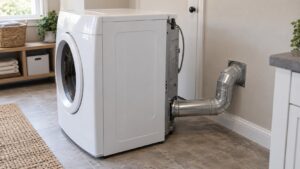
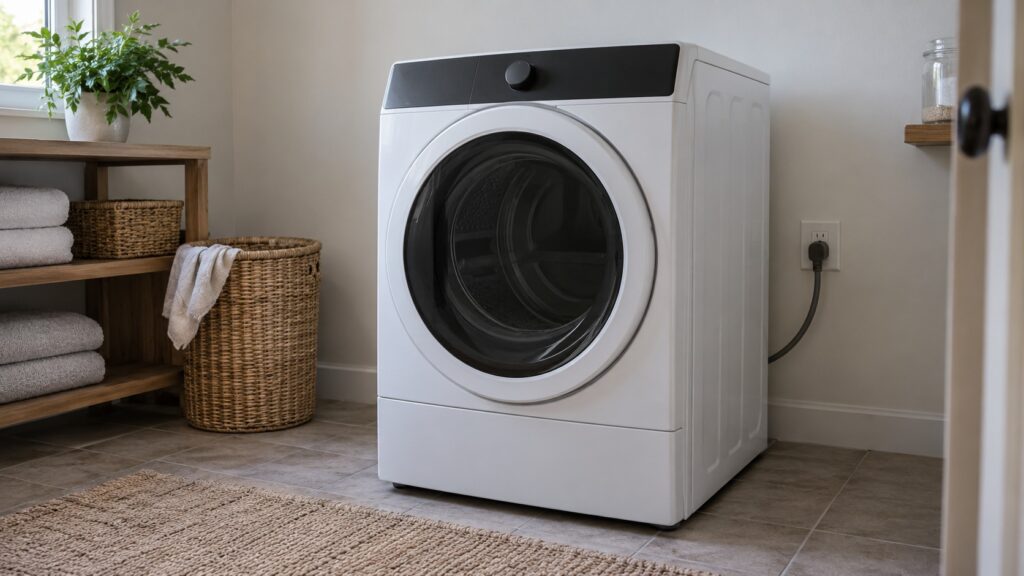
A GE dryer not turning on is most often a power problem, a door that the control does not see as closed, or a blown thermal fuse. Work from the outlet toward the dryer: both breakers on an electric dryer, the outlet and cord, the door and its switch, and only then the parts that need a technician, such as the thermal fuse, the terminal block and the control board. What the dryer does when you press Start (nothing at all, lights without motion, or a hum without a turning drum) tells you which branch to follow.
Why is my GE dryer not turning on?
Because something in the chain from the breaker to the start button is interrupted, and the control will not start a cycle until every link is made. Our symptom page for a GE dryer with no power lists the usual breaks: a tripped breaker, a damaged power cord or plug, a blown thermal fuse and a faulty outlet or house wiring. Our page for a GE dryer not starting adds that a door the control does not detect as fully closed is the most common everyday cause. This page puts those checks into an order you can follow.
Step 1: Is there power at the dryer?
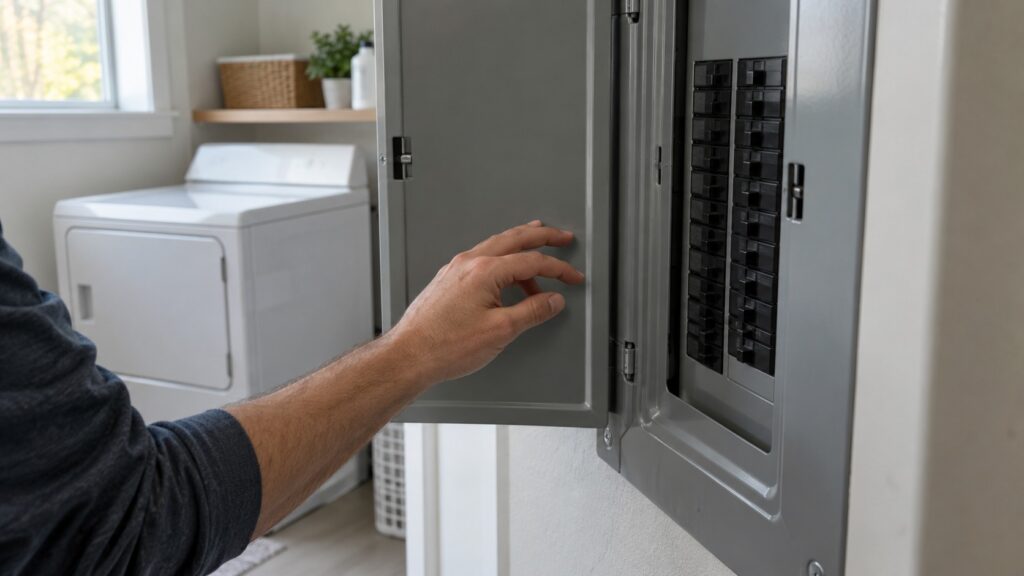
If the dryer shows nothing at all, no display, no light and no sound, start at the panel. An electric dryer uses a 240-volt outlet with two separate breakers, so a single tripped breaker can leave the dryer partly or fully dead depending on which circuit it affects. Check both breakers. A gas dryer still needs standard 120-volt power for the controls and the drum motor, so confirm that outlet has power by testing another device in it. Look at the plug and the cord for visible damage. Do not open the terminal block cover or the back of the dryer; the terminal block and the cord connection are for a technician.
If you smell burning or see damage near the cord or outlet, do not try to restart the dryer. Switch off the breaker at the panel while standing on a dry floor, and never pull a plug from a wet or scorched outlet.
Step 2: Is the control seeing the door as closed?
If the display lights but the drum never turns, check the door. The control will not start without confirmation from the door switch, so a door that is not fully closed, or a switch that does not signal correctly, stops the cycle. Open the door, check that no clothing or lint is caught at the edge, close it firmly until you hear it latch and try again. If the dryer starts only when the door is pressed a certain way, tell the technician, because that points to the latch or the switch. Replacing a door switch is not an owner repair.
Step 3: Could the thermal fuse be involved?
Possibly, on some models. Our symptom pages for no power and for a dryer that will not start say a blown thermal fuse can prevent starting, or cut power to the control, on certain models. Our guides for a dryer that runs without heat describe the same fuse mainly as the part that cuts the heat after an overheat, so sources emphasize different symptoms and we cannot tell you which one your model shows; a technician confirms it. The thermal fuse is a one-time safety device: if the dryer overheats, it blows and has to be replaced, because it cannot reset itself. The usual reason is a restricted exhaust vent, so replacing the fuse without clearing the vent means the new one is likely to blow again. Our guide on the GE dryer thermal fuse and thermistor explains the difference between the two parts, and our GE dryer vent cleaning guide shows how to clear the vent with the dryer unplugged.
What if the motor hums but the drum does not turn?
That is a different branch. A steady hum with no drum movement means the motor is trying to run. According to our page on a GE dryer drum not turning while the motor hums, the likely causes are a broken drive belt, a failed centrifugal start switch inside the motor, a seized drum bearing or roller, or a motor winding problem. Turn the dryer off promptly rather than letting the motor hum, and do not try to turn the drum by hand while the dryer is connected. Our guide to GE dryer drum rollers and belt explains the sounds each failed part makes. Belt and motor work means opening the cabinet, so it is a technician’s job.
What if it runs but does not heat?
Then the dryer is turning on, and the problem is heat. Read our GE dryer not heating guide and the GE dryer won’t heat diagnostic, which start with the exhaust vent, then the thermal fuse, then the element or igniter. If the display shows E3, our GE dryer E3 code guide explains that the exhaust air is running hotter than expected, and that the leading cause is a blocked vent.
When should you call a technician?
Call when both breakers are on, the outlet is live and the door closes firmly, but the dryer still does nothing; when you see damage at the cord, plug or outlet; when the motor hums without the drum turning; or when a thermal fuse is suspected. The technician tests the cord, the terminal block and the breaker circuit, then the thermal fuse and the door switch, before any part is fitted. An older dryer with several failed parts is worth comparing against replacement. Our GE dryer repair page explains the visit, and you can book it online with the model number ready.