Installing a GE Café CEB1599SJSS or CEB1590SSSS countertop convection microwave is simpler than a built-in or over-the-range model, but a few rules decide whether it runs safely: a flat, strong counter, open space around its vents, a grounded outlet used by nothing else heavy, and cookware chosen for convection. Both are 1.5 cubic foot stainless countertop ovens that combine microwave cooking with a convection heating element and fan, and they share the same platform. This guide covers where to put one, what clearances to leave, how to connect power, what to check on the first day, and how to avoid the control faults that a poor location can cause.
Where should a countertop convection microwave go?
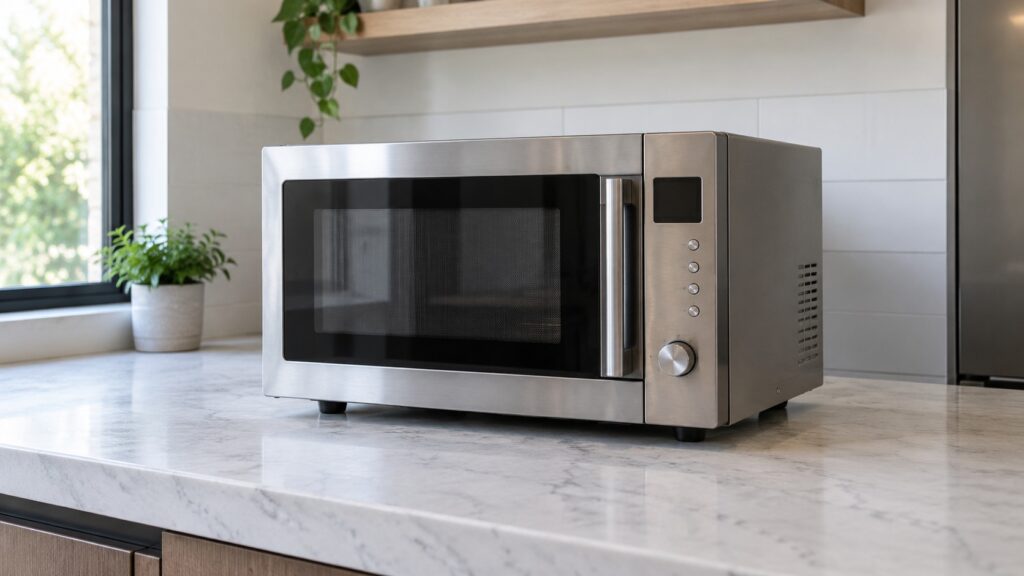
Choose a counter that is flat, firm and rated for the weight. A convection microwave is heavier than a basic microwave because of the heating element, the fan and the extra shielding, and a counter that flexes or a shelf that tilts will let the unit rock. Keep it away from the stove, the sink and the toaster. Steam from a pot on the cooktop condenses on a cool control panel, and a convection oven that sits beside a heat source has to work harder to shed its own heat.
Think about the door. The door should open fully without striking a wall or a cabinet, and you should be able to reach the controls and lift out hot food without leaning over a burner. Place it at a comfortable height, since a heavy dish of hot food held high is a burn risk. A location below chest height is better.
How much clearance does the microwave need?
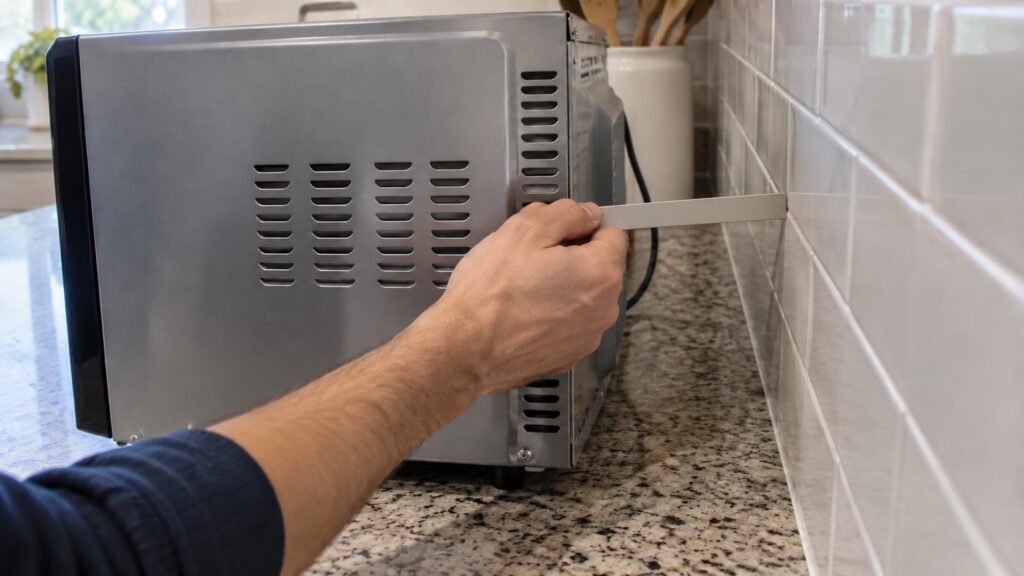
Air must move around the cabinet. The back, top and sides have vents that let out heat, and convection cooking makes far more heat than microwave-only cooking. The manual lists the clearance for each side, and you should leave at least those distances. Do not push the unit against a wall or tuck it under a cabinet unless the manual says that is allowed, since trapped heat stresses the electronics. Do not set anything on top of it, and do not drape a towel over it.
If you hope to build it into cabinetry, the manual for your model states whether that is permitted and whether a trim kit is required. Do not enclose a countertop unit that is not approved for it, because a convection microwave inside a closed cabinet cannot cool itself.
What power does it need?
Plug it into a grounded outlet that is on a circuit with enough capacity, as the manual specifies, and do not share the circuit with a toaster oven, a kettle or another high-draw appliance. Never use an extension cord, a plug adapter or a power strip, and never cut off the grounding pin. Keep the cord clear of the hot cabinet sides and away from the sink, and do not let it hang over the counter edge where it can be pulled. A convection microwave draws more current when the element is on, so a circuit that is shared is a common cause of a tripped breaker mid-roast.
What should you do on the first day?
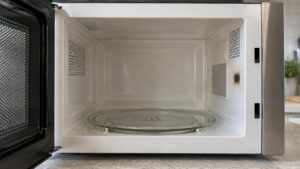
- Remove all packing from inside and outside, including any film on the stainless and the cardboard between the turntable and the floor.
- Seat the turntable and its ring so the plate turns freely without catching.
- Set the clock and read the manual’s lock and reset instructions, so you know how to release a control lock.
- Run it with a cup of water for about a minute as a microwave. Never run a microwave empty.
- Follow the manual’s first-use instructions for convection. A new element can smoke slightly the first time, so ventilate the kitchen.
Then check the unit sits flat, the door closes with a firm click, and nothing blocks the vents. Our GE microwave installation guide covers the general rules that apply to every model, and our over-the-range versus countertop guide explains why you might pick one over the other.
What cookware and metal can you use?
For microwave cooking, use microwave-safe glass or ceramic and keep metal out. For convection cooking, use oven-safe dishes and the rack or tray the manual supplies, and keep all metal clear of the walls and the door so nothing arcs. Do not mix the two modes with metal in the cavity unless the manual shows a combination setting that allows it. If you see sparks, stop the microwave at once; our sparking and arcing page explains the causes.
How can a poor location lead to faults?
Two electronic faults dominate on these models. F3 means the touchpad has shorted, and F1 and F2 mean the thermal sensor has an open circuit or has shorted. Steam, spills and heat near the panel contribute to touchpad problems, and a unit that cannot shed heat strains the sensors and the control. A good location helps avoid both. Read our GE microwave F3 guide and our F1 and F2 guide if either appears, and see our microwave maintenance guide for the cleaning routine that protects the panel. A convection microwave that stops browning food may have a heating element problem, which a technician should test.
When should you call a professional?
You can set up a countertop unit yourself. Call a professional if you plan to build it in, if the outlet or circuit needs work, or if the microwave does not heat, shows a code or trips the breaker after setup. Our GE microwave repair service can look at it, and we are an independent service that will say plainly whether the fault is the installation or the microwave. You can book a visit online.